


Facial regeneration and volume restoration utilizing SVF (Stromal Vascular Fraction) is a procedure that creates an environment for the engraftment of transplanted tissue using regenerative cells and growth factors isolated from adipose tissue. SC301 Clinic holds both a Cell Processing Facility License (No. 139) and a Designation as an Advanced Regenerative Medicine Institution (No. Regenerative-1-0049), operating an in-house one-stop system that eliminates the need for external transfers. However, surgical outcomes vary from person to person, and it is essential to have a thorough consultation with the medical staff regarding recovery patterns and the potential for side effects.
🧬 In-depth analysis of anatomy/paper mechanisms
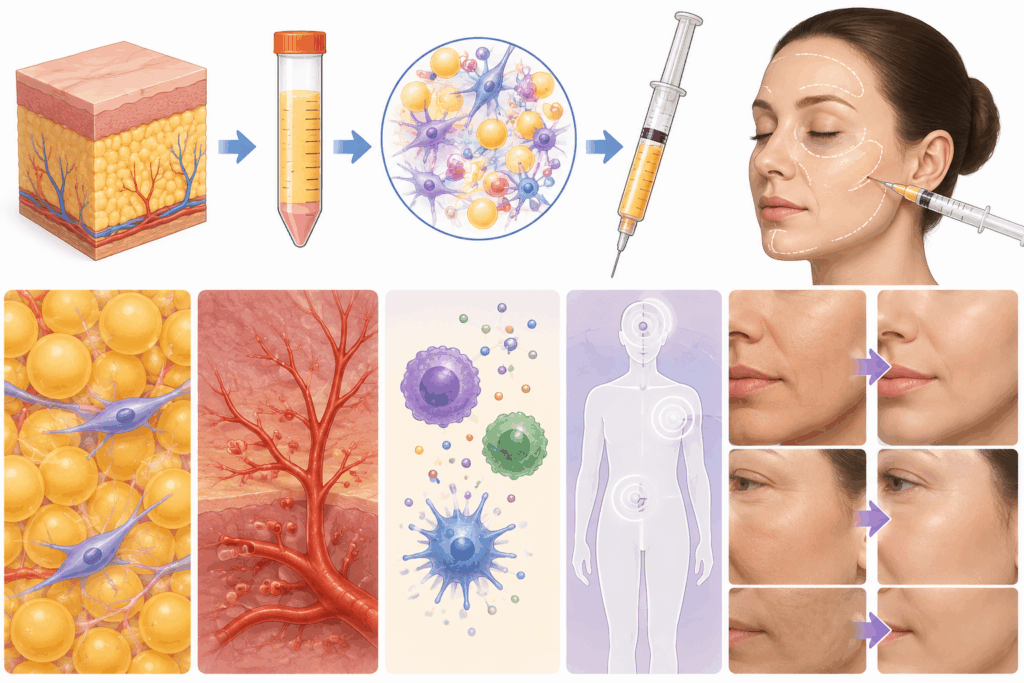
Cellular Mechanisms and Anatomical Characteristics of SVF (Schemovascular Fraction) Facial Regeneration
While fat grafting is a representative method for creating natural volume using autologous tissue, traditional simple fat grafting has limitations, such as absorption or necrosis, due to insufficient blood flow to the center of the transplanted fat tissue. To compensate for these limitations, the SVF (Matrix-Vascular Fraction) method was introduced. This method utilizes a cell aggregate obtained by enzymatically treating and centrifuging fat tissue, containing various regenerative cells and growth factors, including Adipose-Derived Stem Cells (ADSCs). The core mechanisms at play when SVF binds to tissue are broadly categorized into differentiation, angiogenesis, immunomodulation and anti-inflammation, and homing. The differentiation mechanism involves directly transforming into necessary tissue cells to fill empty spaces lacking volume. Angiogenesis plays a key role in increasing engraftment rates by inducing the growth of new capillaries to supply oxygen and nutrients to the transplanted tissue. Furthermore, through immunomodulation and anti-inflammatory actions, cytokines, growth factors, and exosomes are secreted to alleviate local inflammation and promote regeneration. Homogenesis is the characteristic of the tissue to autonomously locate damaged or inflamed areas to aid in the healing process.
Stem cell (SVF) anti-aging surgery, which applies these SVFs to the face, restores sunken volume in areas such as the cheeks, temples, forehead, nasolabial folds, and under-eyes, while simultaneously improving skin texture, elasticity, and tone, and aiding in the regeneration of atrophic scars and depressed tissues. To fully maintain the activity of these regenerative cells, the entire process—from harvesting to isolation and injection—must be carried out in a strictly sterile in-house cell processing facility without external outsourcing. Since the loss rate of cells increases over time after purification outside the body, it is advantageous for creating an environment for engraftment to immediately apply fresh cell tissues through a close flow between the in-house laboratory and the operating room, without transporting them externally. However, the response and regenerative capacity of these biological tissues may vary depending on the individual patient's physical condition, age, and hormonal status, and the same results are not guaranteed for all patients.
(I.e. Clinical Evidence (Interpretation of Paper Figures)
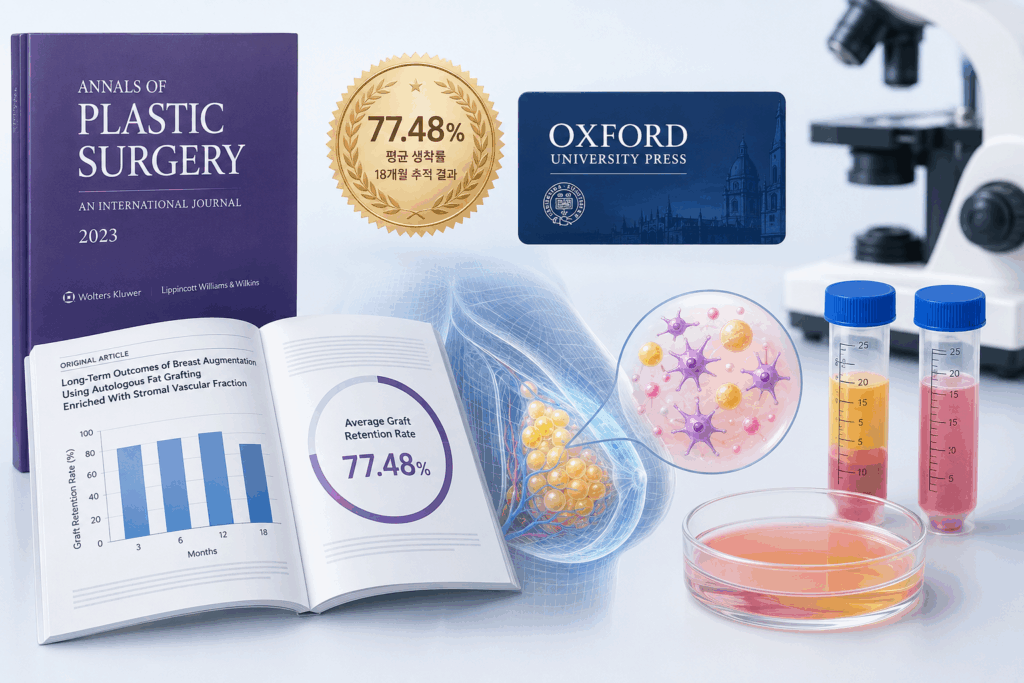
The scientific verification process of SVF procedures, based on research papers and clinical data, serves as an important indicator when selecting a medical institution. According to a study published in the SCI-indexed international journal *Annals of Plastic Surgery* (2023), the average engraftment rate of stem cell (SVF) breast augmentation reached 77.48% based on 18-month long-term follow-up clinical results. This figure was derived through a rigorous multi-layer transplantation protocol and precise cell separation process, although individual differences exist depending on the patient's constitution and post-operative care status. Furthermore, research related to SVF has been published in the Oxford University Press journal, adding to its academic credibility.
To support these clinical results, SC301 Clinic has verified safety and efficacy by accumulating and analyzing over 9,000 proprietary clinical data points over the past 19 years. In clinical practice, we strictly avoid excessive overfilling and apply a multi-layer grafting method that injects the appropriate amount in micro-units. Through this, we minimize the possibility of side effects such as calcification or cysts that may arise from necrotic fat, and we operate a protocol designed to reduce the physical burden on patients and produce natural-looking results. However, as this surgical procedure may be accompanied by side effects such as swelling, inflammation, and bleeding depending on the individual, diagnosis by medical professionals and meticulous attention are essential.
📊 Treatment Method Specification Comparison Table
| Procedure method | Processing method | Cell state and composition | Key Features and Key Factors | Commercialization and Safety Review |
| Simple fat grafting | Only adipose tissue is harvested and immediately transplanted | Low in effective regenerative cells and composed mainly of pure fat | There is a possibility of high absorption and necrosis due to lack of central blood supply. | The procedure is simple, but the engraftment rate is relatively low. |
| Cultured stem cells | Cells from the collected tissue are cultured in vitro for several weeks. | Proliferation primarily of a single lineage of adipose-derived stem cells (ADSCs) | There is a possibility of cell deformation and the existence of contamination, overproliferation, and regulatory burdens associated with in vitro culture. | Clinical application is difficult due to the need for strict regulations and infection control. |
| Non-cultured SVF (SC301 method) | Immediate separation via enzyme treatment and centrifugation on the day of collection, followed by transplantation. | Autologous cells in their original state, stem cells, various regenerative cells, and a collection of growth factors | Separation efficiency and engraftment rate are key, and an in-hospital one-stop system without external movement is applied. | Based on data from an SCI-indexed journal (2023) showing a 77.48% engraftment rate (individual differences may apply) |
❓ Top 5 FAQs
Q. What is the difference between stem cell (SVF) anti-aging surgery and regular fat grafting?
Conventional fat grafting primarily involves the transplantation of pure fat, which can lead to a high absorption rate due to insufficient central blood supply. In contrast, stem cell (SVF) anti-aging surgery involves transplanting regenerative cells isolated from fat tissue along with growth factors to induce the formation of new blood vessels and enhance the environment for engraftment. However, the pattern of engraftment may vary depending on an individual's constitution.
Q. Why are the in-hospital cell processing facility and the designation as an advanced regenerative medicine institution important?
The Cell Processing Facility License (No. 139) and the Designation as an Advanced Regenerative Medicine Institution (No. Regeneration-1-0049) are nationally recognized qualifications that require a strictly sterile environment, precision separation equipment, and specialized personnel. Medical institutions holding both qualifications can complete the entire process from collection to separation in-house without external outsourcing, thereby minimizing loss of cell activity and enhancing safety.
Q. What are the side effects or precautions for stem cell (SVF) anti-aging procedures?
Excessive over-injection can cause side effects such as calcification or cysts, so a multi-layer graft protocol involving the injection of appropriate amounts in finely divided doses is necessary. Additionally, swelling, bruising, and inflammation may occur after surgery depending on the individual, and regular follow-up care via ultrasound and 3D scans under the guidance of the medical team is important.
Q. Does the SVF engraftment rate data proven in research papers apply equally to all patients?
No. The average engraftment rate of 77.48% published in the SCI-indexed international journal Annals of Plastic Surgery (2023) is based on 18-month long-term follow-up clinical results, and individual differences exist depending on the patient's age, skin elasticity, health status, and lifestyle.
Q. Are stem cell (SVF) anti-aging surgery and PRP (platelet-rich plasma) treatment the same thing?
No. PRP is a system that extracts growth factors by concentrating the patient's blood and does not contain stem cells. On the other hand, SVF is an aggregate of various regenerative cells and growth factors, including stem cells derived from adipose tissue, so there are differences in cell composition and extraction principles.
???? References
Automatic assembly based solely on verified bibliographic elements of source materials (prevention of creation)
- Annals of Plastic Surgery (2023). Average engraftment rate of 77.48% for stem cell (SVF) breast augmentation proven. 18-month long-term follow-up clinical results.
- Oxford University Press Journal. Listed as a separate study related to SVF (a second paper separate from the engraftment rate paper).
https://blog.naver.com/sc301guide — SC301 Naver Seongchelin Guide
https://record43254.tistory.com/ ㅡ SC301 Tistory
https://www.sc301.co.kr/ — SC301 Official Website


