



Stem cell (SVF) breast augmentationOld stem cell (SVF) breast augmentationThe first thing many people looking into is curious about is the cost.
"Why are prices different at every hospital?"
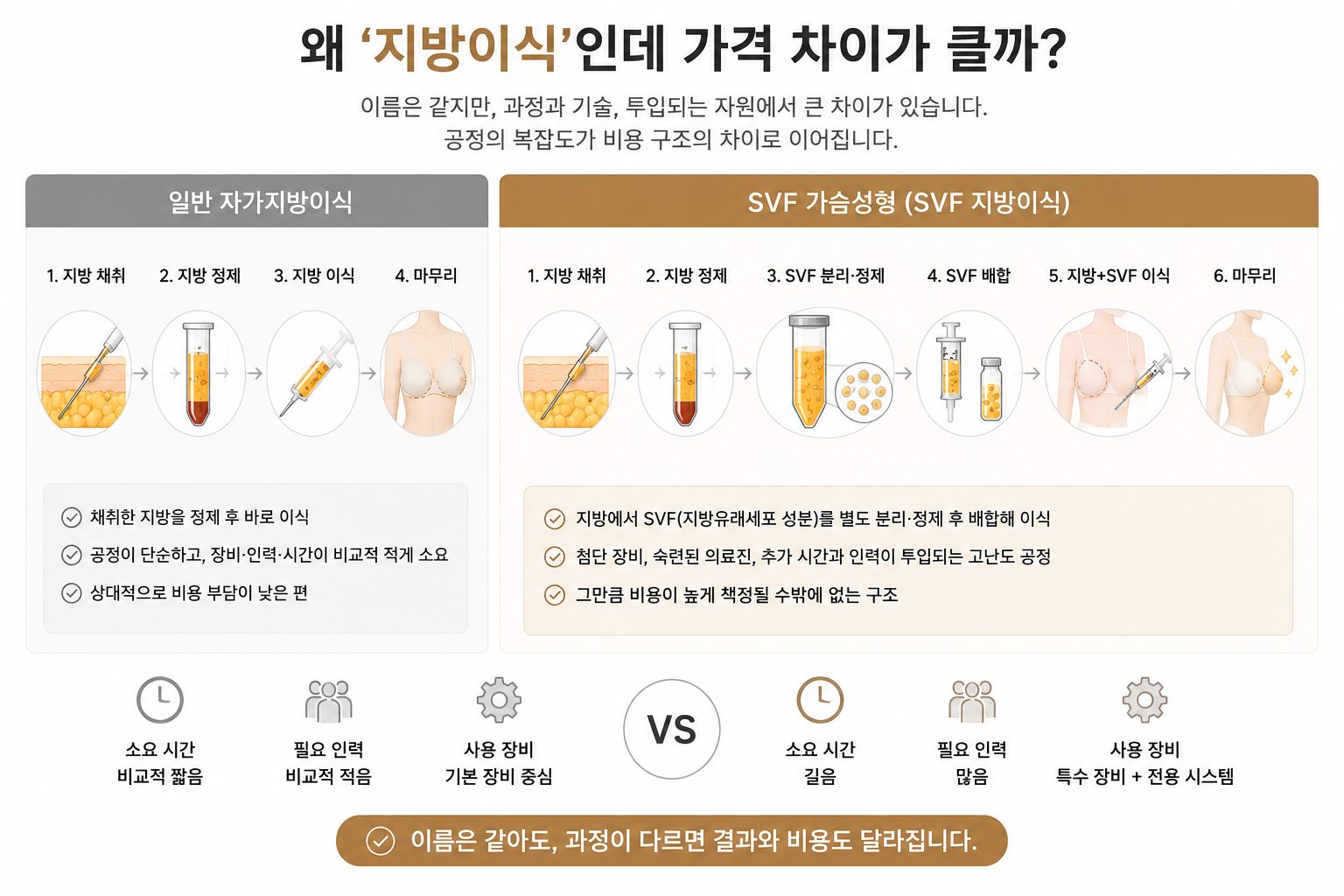
"Why is Stem Cell (SVF) Breast Augmentation More Expensive Than Regular Fat Grafting?"
Gangnam breast augmentation price
Today is SC301's Stem cell (SVF) breast augmentationI will explain the structure in which costs are formed and the layers of value embedded within them, dividing them into four levels.
Why is there such a big price difference for 'fat grafting'?
General autologous fat graftingIt follows a relatively simple process of purifying harvested fat and transplanting it immediately. On the other hand, stem cell (SVF) breast augmentation uses from fat SVF (Adipose-derived cell component)Because an additional process of separately separating, purifying, and blending is required, the necessary Equipment, personnel, and timeThis is an expanding structure.
In other words, both are called 'fat transplantation surgery,' but actually Process complexityThe cost structure changes because it is different.
Level 1 — SVF Research Environment

Unlike simple fat grafting, stem cell (SVF) breast augmentation Cell extraction, purification, and blending processThis is very important.
SC301 operates its own SVF laboratory, where a team of cell specialists directly monitors the SVF status and combines it with purified fats.
Unlike methods that rely solely on automated equipment, we have selected and introduced proven devices to reduce cell damage, and this entire process forms the core foundation for managing engraftment rates.
In fact, SC301 was calculated based on over 9,000 cases Average engraftment rate 77.48%As a hospital listed in the SCI-indexed international academic journal *Annals of Plastic Surgery*, we disclose objective data regarding the environment, technological capabilities, and completeness of our SVF system. (Engraftment rates may vary depending on individual constitution and lifestyle.)
Level 2 — Full package including pre- and post-care

Stem cell (SVF) breast augmentation is not finished just by performing the surgery well. Advance preparationand Post-mortem recovery managementIt significantly influences the survival rate.
SC301 includes the following programs.
✔ Pre-diet management — Lower inflammation levels in the body and breast roomProviding 1:1 customized meal plans to expand
✔ 3D Scanner Precision Analysis — Optimization of procedure design through measurement of breast volume, asymmetry, and skin thickness
✔ Hyperbaric oxygen recovery management — Relieves post-operative swelling and bruising, promotes cell recovery
✔ 6-month follow-up monitoring — Dedicated management of diet, lifestyle, and exercise during the period when fat cells are fully established
Because all these management processes are included, simple Procedure cost It is difficult to compare hospitals based on a single number.
Level 3 — Principle of 3 or fewer surgeries per day

SC301 is Three or fewer surgeries per dayWe will proceed only.
Because stem cell (SVF) breast augmentation is not a simple transplant but a surgery that requires consideration of both the cellular and tissue environments, the medical team's 집중력and designThis is more important than anything else.
Level 4 — Data and Evidence

The previous three levels (Research Environment · Full Package · Surgical PrinciplesThe final layer supporting ) is that all these processes actually Verifiable dataIt is authorized.
SC301 is Over 9,000 clinical experiencesThrough data-based protocols, we provide an optimal surgical environment tailored to each individual's unique body type and tissue condition.
If you summarize the four layers at a glance
I have organized the four layers explained earlier into a table for easy viewing.
By examining how each of these four levels is reflected in the estimate, you can make a much more practical judgment than simply comparing total amounts.
A question more important than cost — "How much management is provided"
Stem cell (SVF) breast augmentation is Graft survival rate, safety, and retentionThe results vary significantly depending on this. Therefore, the criteria more important than price comparison are as follows.
✔ SVF Extraction and purification environmentIs this equipped?
✔ Is there SCI-indexed data on engraftment rates?
✔ Is pre- and post-management operated systematically?
✔ Diagnosis for customized design Equipment and experienceIs this enough?
Frequently Asked Questions
Q. Can I have only regular fat grafting without SVF?
A. Yes, it is possible. However, since the survival rate of conventional fat grafting can vary relatively significantly, you might consider combining it with SVF if you prioritize stability and longevity. It is best to choose based on your own priorities.
Q. Can I also know the cost of the surgery alone, excluding pre- and post-operative care?
A. Depending on the hospital, management programs may be included as standard or are optional, so it is accurate to confirm specifically whether each item is included during the quote consultation.
Q. What might be different when compared to a lower quote?
A. Since there is a possibility that some of the four levels explained earlier (research environment, full package, surgical principles, and data-driven basis) may be omitted, we recommend checking whether these items are included when comparing quotes.
Introduction of the surgeon

This article was written based on the clinical standards of Chief Director Shin Dong-jin (19th year, over 9,000 cumulative procedures performed), who has established the field of stem cell (SVF) breast augmentation. He served as the President of the Korean Society of Stem Cell Plastic Surgery for 10 years, and Only a maximum of 2 to 3 surgeries per dayWe are maintaining the principle of doing so.
As I organize

Stem cell (SVF) breast augmentation is simply Expensive procedureRather, it is a surgery that requires a process that is just as sophisticated and scientific.
If you are comparing several hospitals, I recommend that you compare these four layers—research environment, management processes, and data—rather than just price.
Gangnam breast augmentation price
Procedure costs and results may vary depending on hospital policies and individual constitution and fat conditions. The information above is for reference only, so please confirm accurate costs and diagnosis through an in-person consultation.
Referring to other posts on the Seongchelin Guide blog will help you make a more accurate judgment. This has been the Seongchelin Guide!

Frequently Asked Questions
Why is stem cell (SVF) breast augmentation more expensive than regular fat grafting?
Standard autologous fat grafting follows a relatively simple process of purifying harvested fat and transplanting it immediately. In contrast, stem cell (SVF) breast augmentation requires additional steps, such as separating and purifying SVF (fat-derived cell components) from fat before blending it. This structure increases the necessary equipment, personnel, and time. Although both procedures involve fat transplantation, their cost structures differ due to the varying complexity of the actual processes.
Can I get regular fat grafting without SVF?
It is possible. However, since the survival rate of conventional fat grafting can vary relatively significantly, you might consider combining it with SVF if you prioritize stability and longevity. It is best to choose based on your own priorities.
Can I also know the cost of the surgery alone, excluding pre- and post-operative care?
Depending on the hospital, management programs may be included as standard or are optional, so it is accurate to confirm specifically whether each item is included during the quote consultation.
What might be different when compared to a low quote?
As there is a possibility that some of the four levels—research environment, full package, surgical principles, and data basis—may be omitted, we recommend checking whether these items are included when comparing quotes.
How is the SVF research environment reflected in the cost?
In stem cell (SVF) breast augmentation, the processes of cell extraction, purification, and blending are critical. SC301 operates its own in-house SVF laboratory where a team of expert researchers directly monitors the SVF's condition and blends it with purified fat. Unlike methods that rely solely on automated equipment, SC301 has carefully selected and introduced verified devices to minimize cell damage, and this entire process serves as the core foundation for managing the engraftment rate.
What pre- and post-care is included in the cost?
It includes personalized 1:1 pre-operative dietary management to lower inflammation levels, precise 3D scanner analysis to measure breast volume, asymmetry, and skin thickness, hyperbaric oxygen recovery care to alleviate post-operative swelling and bruising, and 6-month post-operative monitoring to manage diet, lifestyle, and exercise during the fat cell settling period. SC301 Clinic operates these programs as part of its basic curriculum.
What is the reason for limiting the number of surgeries per day?
SC301 performs no more than three surgeries per day. This is because stem cell (SVF) breast augmentation is not a simple transplant but a surgery that requires consideration of both the cell and tissue environment, making the medical team's concentration and planning paramount.
Where can I check the graft survival rate data?
SC301 has published and disclosed an average engraftment rate of 77.48%, calculated based on approximately 9,000 cases, in the SCI-indexed international journal *Annals of Plastic Surgery*. The engraftment rate may vary depending on individual constitution and lifestyle habits.
What criteria should I use when comparing prices?
It is recommended to evaluate based on criteria such as whether the SVF extraction and purification environment is equipped, whether SCI-indexed engraftment rate data is available, whether pre- and post-treatment management is systematically operated, and whether there is sufficient diagnostic equipment and experience for customized design.
Why is precise 3D scanner analysis necessary?
This is done to optimize the procedure design by measuring breast volume distribution, asymmetry, and skin thickness. It is utilized to design a surgical environment tailored to each individual's unique body type and tissue condition. Based on these analysis results, SC301 Clinic avoids excessive over-injection and designs a natural three-dimensional effect.


