Iranian research team — 18 patients with androgenetic alopecia were randomly assigned to a PRP monotherapy group and an SVF+PRP combination group, and changes in hair density and thickness were compared over 20 weeks using trichoscopy.
SC301 Clinic · Stem Cell Research Series · Based on a Single Paper · SVF+PRP Combination Scalp Injection
Original paper information:
Behrangi E, Rahimi ST, Zare S, Goodarzi A, Ghassemi M, Khodadad F, Nouri M, Mozafarpoor S, Dehghani A, Nilforoushzadeh MA, Roohaninasab M.
"Evaluation of the effects of adding an adipose tissue-derived stromal vascular fraction to platelet-rich plasma injection in the treatment of androgenetic alopecia: A randomized clinical trial"
Skin Research and Technology. 2024;30(4):e13700.
doi: 10.1111/srt.13700.
Affiliation: Iran Multi-institutional Collaborative Research (Dermatology)
Wouldn't it be better to add SVF to PRP?
Androgenetic alopecia (AGA)It is a common type of hair loss known to affect up to 80% of men and up to 50% of women. Although autologous platelet-rich plasma (PRP) is already a widely used method in hair loss treatment, concerns have consistently been raised that its effects are limited or temporary.
So in recent years Adding adipose stem cells (SVF) to PRP will double the effect.Various combination therapies have been attempted under the expectation that [this] is better. However, there have not been many randomized studies that directly compared whether adding SVF is actually better than PRP alone.
This study was designed to answer that very question.
Between the group that received only PRP injections three times and the group that added SVF to the first injection followed by PRP—which group showed better hair density and thickness after 20 weeks? An Iranian research team randomly assigned 18 participants to directly compare the two groups.
PRP and SVF differ starting from their mechanism of action.
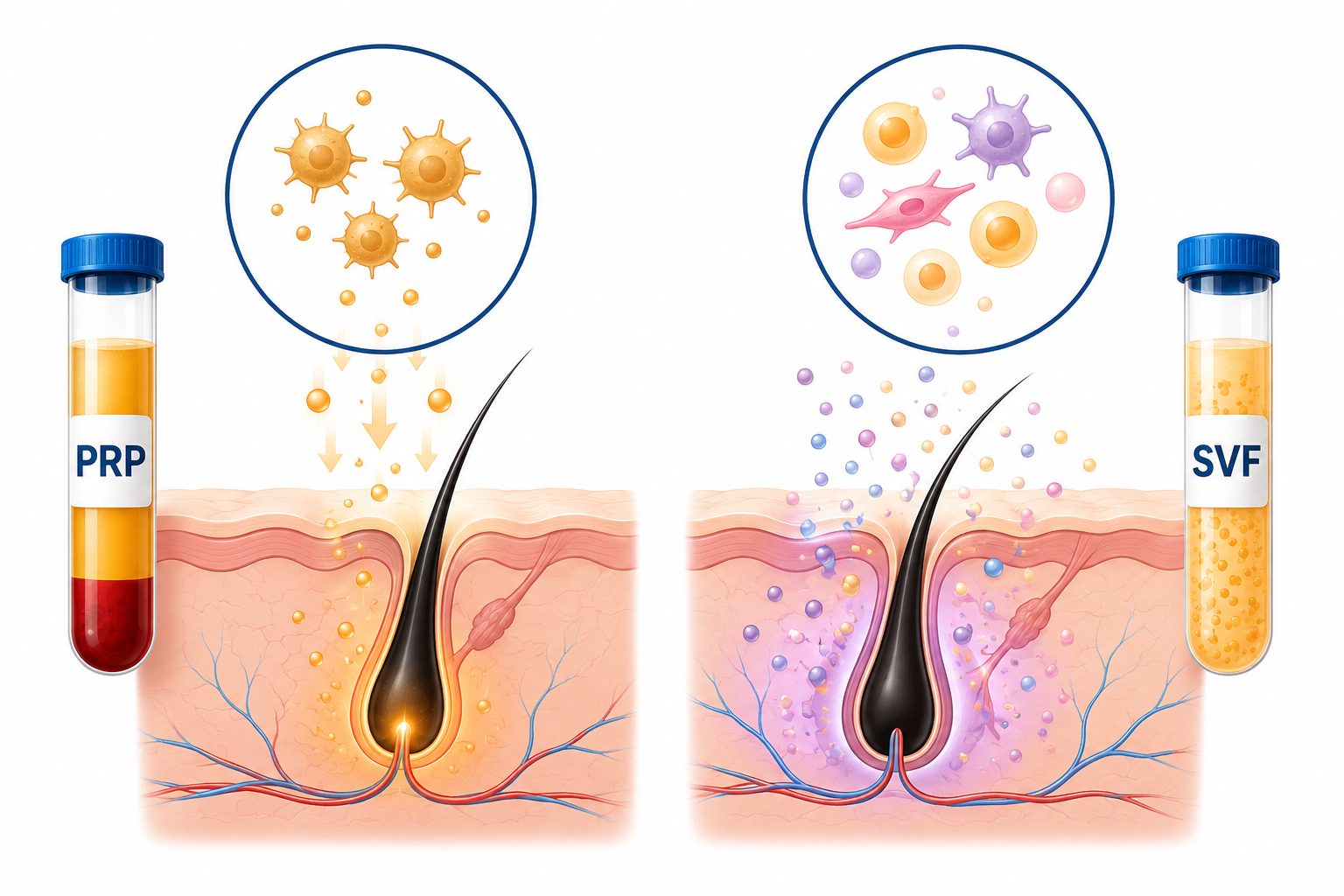
Although PRP and SVF are used similarly in hair loss treatment The pathways acting on the hair follicles are different. PRP stimulates cell signaling through growth factors released from platelets, while SVF approaches the problem by improving the environment around the hair follicle through various cells and secretions obtained from adipose tissue.
Pathway of action of PRP
● Activation of β-catenin and FGF-7 signaling
● Protects hair follicles through anti-apoptotic (Bcl2) effects
● A method already proven in hair loss treatment
● Standardized protocols are still absent
The action pathway of the SVF
● Secretion of growth factors such as IGF-1 and PDGF
● Improve hair follicle environment with anti-inflammatory cytokines
● Includes Adipose-derived stem cells (ASC), expected to have regenerative potential
● The collection and processing process is more complex compared to PRP.
Study Design — Same Conditions, Different Prescriptions
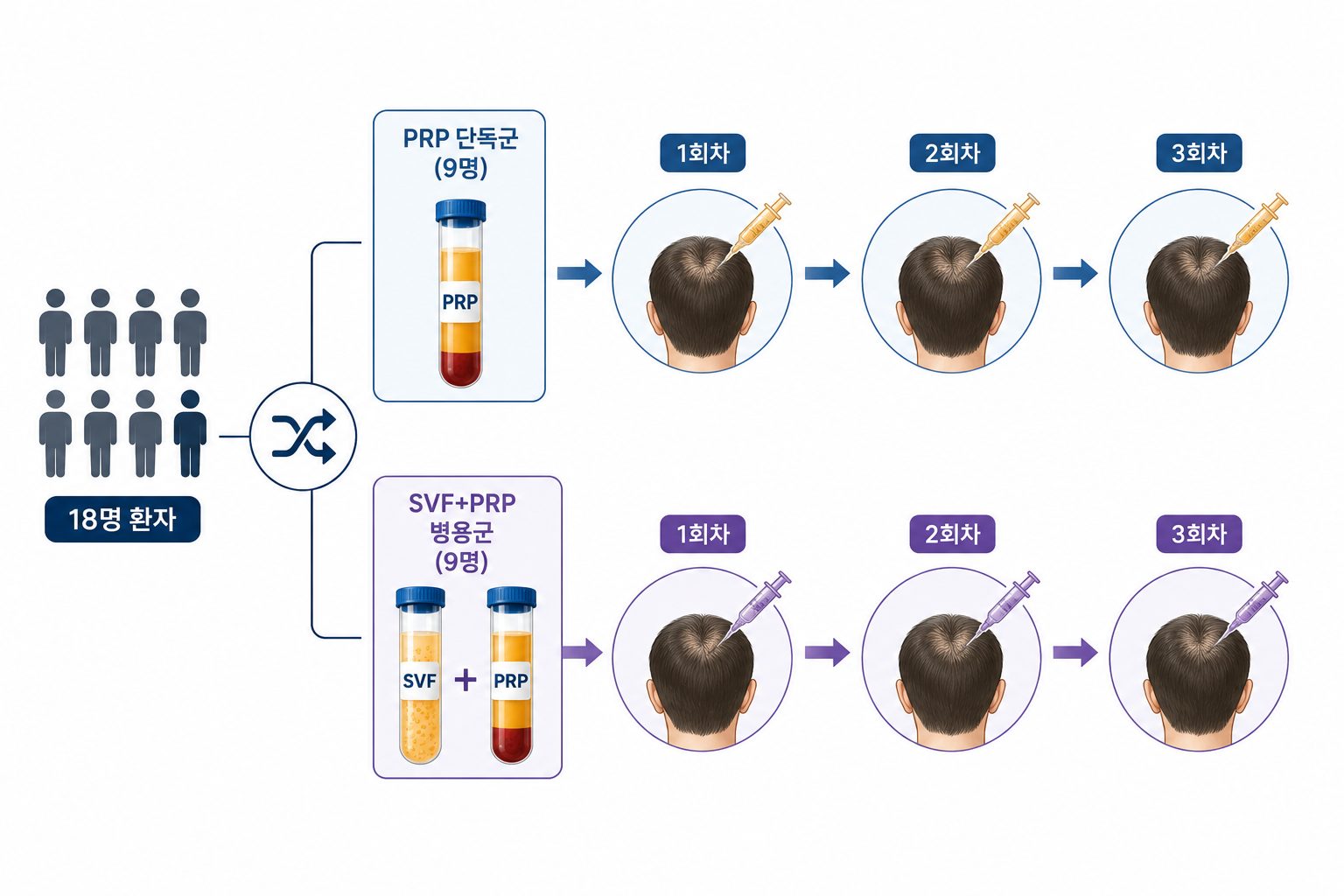
18 patients PRP alone group (9 people)and SVF+PRP combination group (9 people)They were randomly assigned. Both groups visited a total of 3 times, but the procedures received at each visit were different.
PRP alone group (9 people)
PRP injections for all 3 sessions
● Visit 3 times at 1-month intervals
● Inject only PRP into the scalp every session
● Intradermal injection using a 1mL syringe and 30G needle
SVF+PRP combination group (9 people)
1st SVF, then PRP
● 1st Session: SVF Injection
● 2nd & 3rd Sessions: PRP Injection (1-month intervals)
● Use the same injection method and site
Trichoscopy — Measuring Hair Numbers
How were hair changes measured objectively?
In this study Polarized Trichoscopy (KC Hair Polarizer)We used [the device] to photograph the same area of the scalp before and after the procedure. We measured the number of hairs per unit area using a ×60 magnification lens and the average thickness of individual hairs (in millimeters) using a ×150 magnification lens. In addition, VisioFace imaging was added to comprehensively record the condition of the scalp.
Much more precisely than visual evaluation or photo comparison, Check in numbers whether your hair has actually grown longer or thickened.This is a possible method.
20 Weeks Later — Unexpected Results
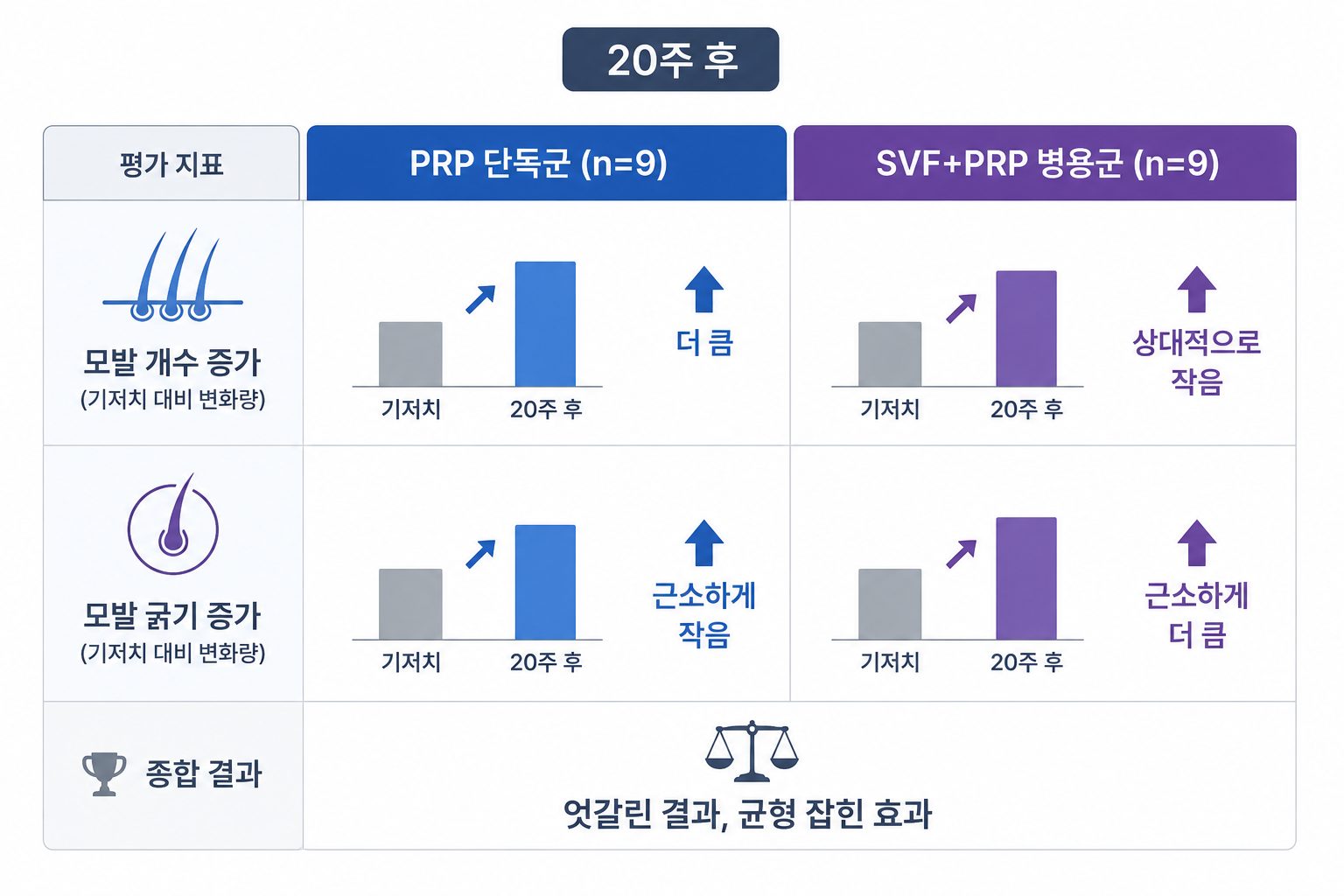
Key Results (Conflicting Results)
Both groups showed a significant increase in hair thickness and count compared to baseline. However, The increase in hair count was actually greater in the PRP monotherapy group than in the SVF+PRP combination group, and, The increase in hair thickness was slightly greater in the SVF+PRP combination group. It is a balanced result, contrary to the expectation that "adding SVF is always better."
1
Hair count — PRP-only group increased more significantly
When comparing the change in hair count after 20 weeks, The increase in the group that received only PRP injections three times was greater than that of the SVF+PRP combination group. It shows that adding SVF is not always advantageous in terms of hair count.
2
Hair thickness — SVF+PRP group slightly superior
In changes in hair thickness The SVF+PRP combination group showed a slightly larger increase than the PRP alone group....was shown. However, the difference is "slight," so it is difficult to view it as an overwhelming advantage.
3
Both groups showed a significant improvement compared to baseline.
Regardless of superiority or inferiority between groups, Both the PRP alone group and the SVF+PRP combination group showed significant improvement in hair thickness and count compared to before the procedure.That is it. In other words, the fact that both methods are "effective" is a confirmed fact in this study.
XNUMX
There was no correlation between age, gender, and treatment effectiveness.
The research team also examined whether age or gender affects treatment outcomes, but In this study, no significant correlation was found. However, the research team itself mentioned that this is likely due to the small sample size.
The two treatments work through different pathways.
The reason for these conflicting results is that PRP and SVF to the hair follicles Because they work in different waysIt is possible. Rather than one side being superior, it is possible that each has different areas of strength.
PRP — Signaling Activation
Stimulates the β-catenin and FGF-7 pathways to promote entry of hair follicles into the growth phase.
PRP — Cell Protection
Preservation of existing hair follicles through anti-apoptotic action via BCl2 release
SVF — Growth Factor Supply
Secretes IGF-1 and PDGF to support the regeneration of tissues surrounding hair follicles.
SVF — Improvement of the inflammatory environment
Suppressing adverse inflammatory responses in hair follicles with anti-inflammatory cytokines
What this study says — "more complex treatment = better results" is not true
The value of this research is The fact that it verified the common belief that "adding SVF is always better."It is located there. The results were not that simple. The number of hairs was actually better in the PRP-only group, while the SVF+PRP combination group was slightly ahead in thickness.
this is The need to select different approaches depending on the treatment goalThis suggests that if increasing hair count is the priority, PRP alone may be sufficient, but if improving hair thickness is more important, there is room to consider adding SVF. This is the practical message of this study.
The conclusion reached by the paper
In the treatment of androgenetic alopecia, both the PRP monotherapy group and the SVF+PRP combination group After 20 weeks, hair thickness and count increased significantly compared to baseline.I did.
However, in comparisons between groups The PRP alone group showed slightly better results in hair count, while the SVF+PRP combination group showed slightly better results in hair thickness.Based on the results, it was difficult to conclude that the addition of SVF was unilaterally superior. The research team stated that a larger-scale follow-up study is needed.
Stories from SC301 Clinic
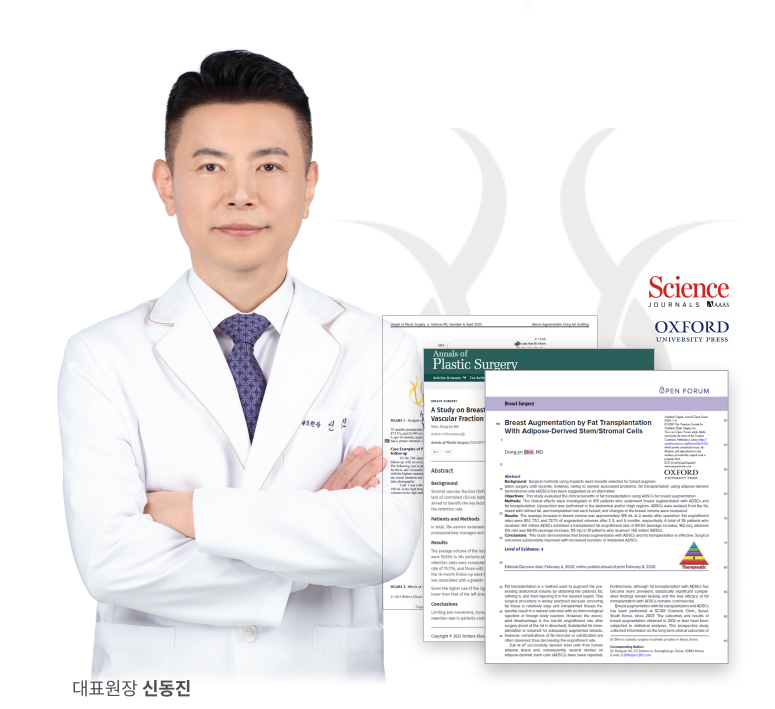
Many people considering hair loss treatment believe that "the more expensive and complex the treatment, the greater the effect." This study provides a balanced perspective on that common misconception.
Since PRP and SVF act on hair follicles through different pathways, combining them does not guarantee that all indicators will improve simultaneously. The important thing is to design an evidence-based treatment tailored to the patient's desired direction of improvement (whether it is hair count or thickness).
SC301 Clinic continuously reviews the latest evidence regarding SVF and PRP, and Treatment based on actual data rather than exaggerated expectationsI will aim for this.