



What if you could turn back your skin age by 30 years?
This question, which would have sounded like science fiction just a few years ago, is now being addressed by a world-class research team
We are getting one step closer to reality.
Today, we will look at cell reprogramming technology, which is receiving the most attention in the biotechnology field, and Cambridge University research teamI will explain the amazing breakthrough this created step by step.
Why do the cells in our bodies age?
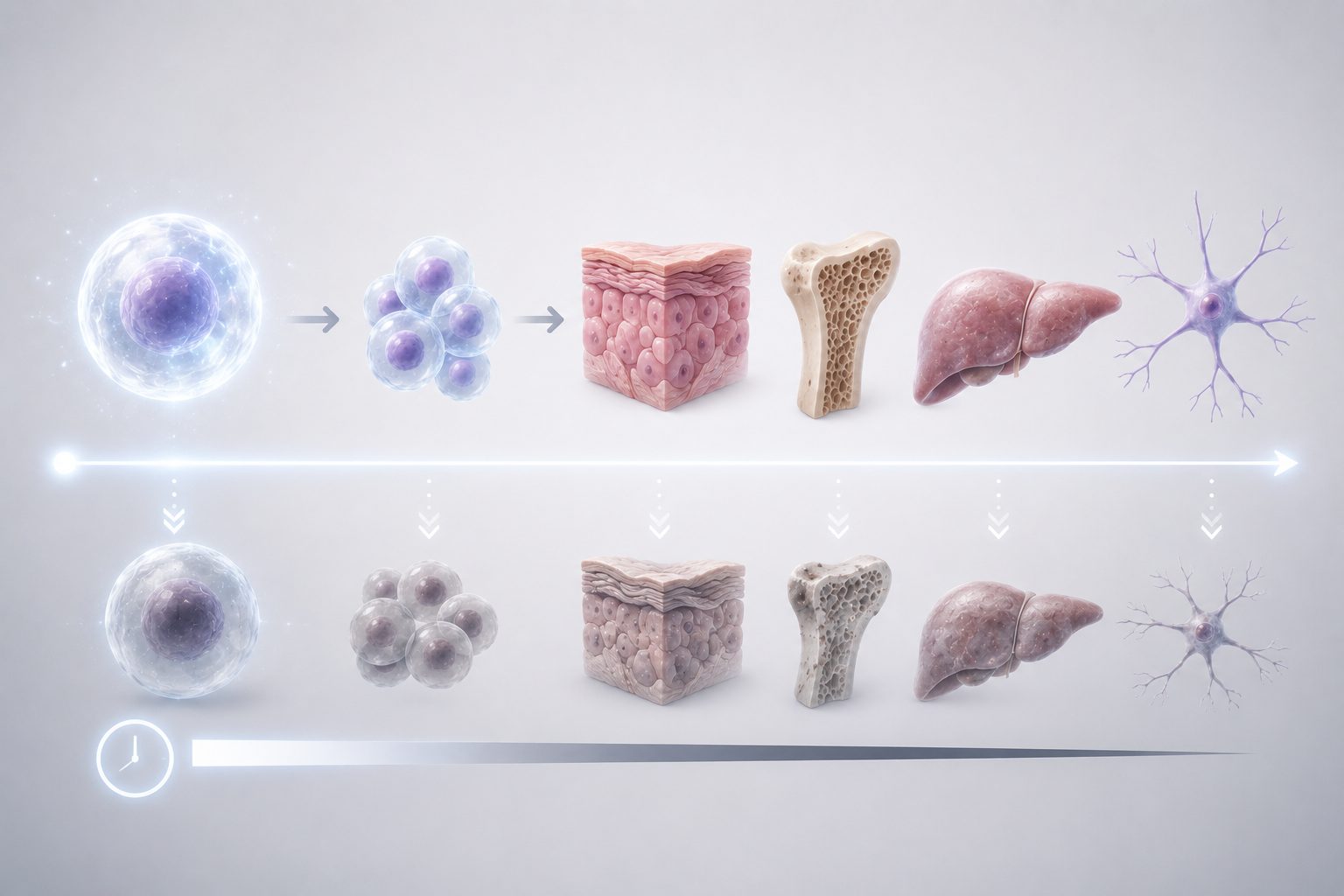
At birth, the cells in our body have not yet decided what role they will play. Stem cell state.
while time is passing by These cellsEach part, such as skin, bone, and liver Differentiate according to roleAnd once differentiated, the cell returns to its original state.
The fact that one cannot return to a state is a long history of biology.
It was common sense.
And differentiated cells lose function over time, and regenerative abilityof I am losing it. This is what we experience The cellular reality of aging.
The discovery that changed everything, the Yamanaka factor

In 2006, Japanese Professor Shinya Yamanaka made a discovery that rewrote biology textbooks.
Four specific proteins, Oct4·Sox2·Klf4·c-MycWhen injected into adult cells, the cell clock turns back to an initial state where it can transform into any cell,
in other words Induced pluripotent stem cells (iPSCs)It was discovered that it returns to.
These four proteins are later Yamanaka FactorIt came to be called by that name, and this research won the 2012 Nobel Prize in Physiology or Medicine.
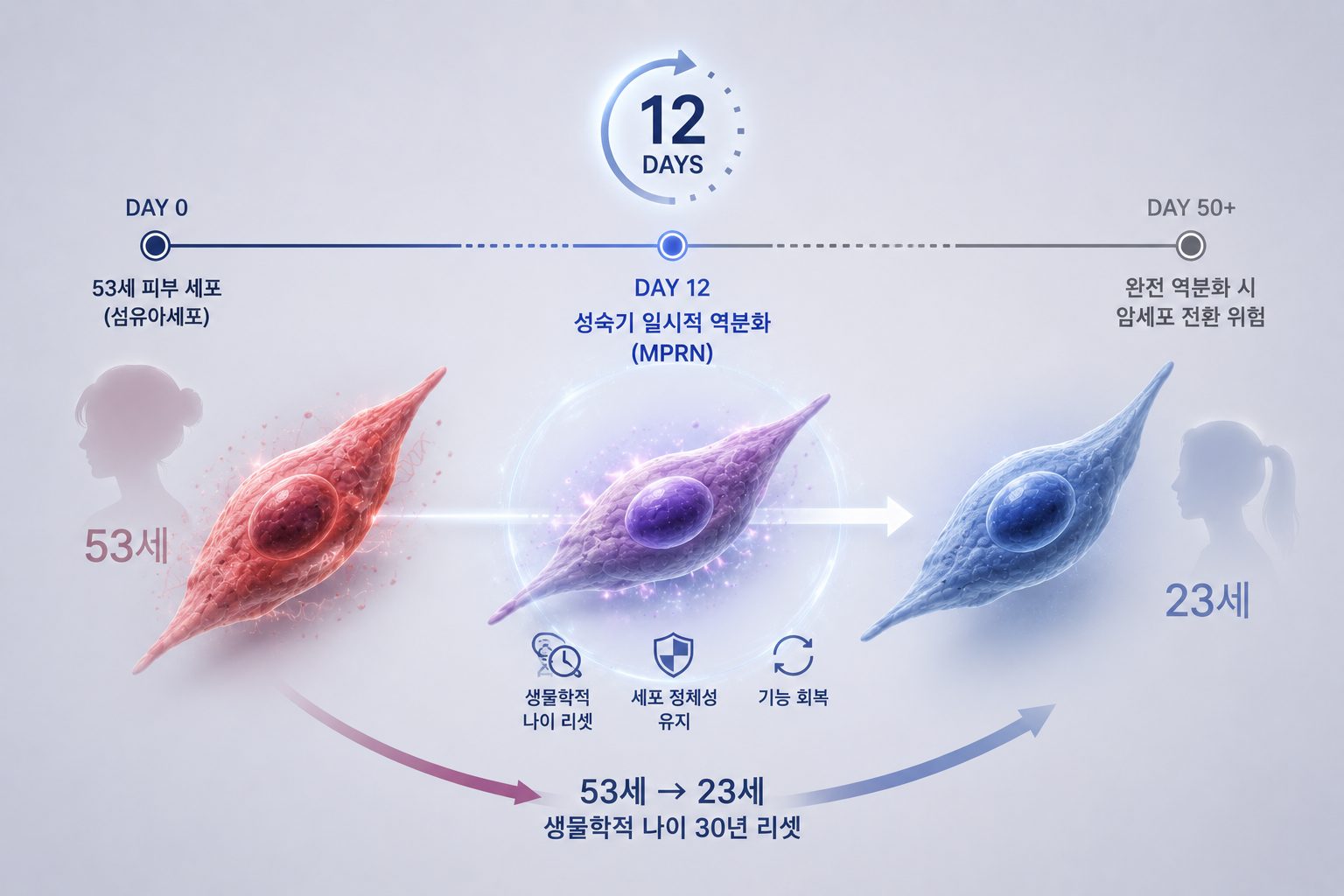
However, in this technology Fatal LimitationsThere was. If cells are exposed to the Yamanaka factor for too long, for about 50 days or more, the cells completely lose their original identity and Out of controlbecome cancer cellsThere was a very high risk of it changing into.
It was a paradox where trying to turn back the cell's clock actually ended up damaging the cell itself.
Cambridge Research Team's Innovation, Created in 12 Days
miracle
Researchers at the Barbraham Institute in Cambridge, UK, have developed a completely new approach to overcome this limitation.
I tried the approach.
The core idea was simple yet revolutionary. Before completely reverting the cell back into a stem cell, exactly Stopping the process at the 12th day.
The research team attached the Yamanaka factor to fibroblasts, the skin cells of a 53-year-old experiment participant. Exposure for only 12 daysI ordered it.
It is a much shorter time compared to the existing 50 days. The results were surprising. The cell, the original "I am a skin cell" While maintaining its identity and function, Only the biological age related to aging is accurate Reset to the state of being 23 years old, 30 years agoIt has been done. The research team used this method Maturity Phase Transient Redifferentiation (MPRN)It was named as such.
Have I really gotten younger? Three pieces of evidence
It is not simply that he looked young to the eye.
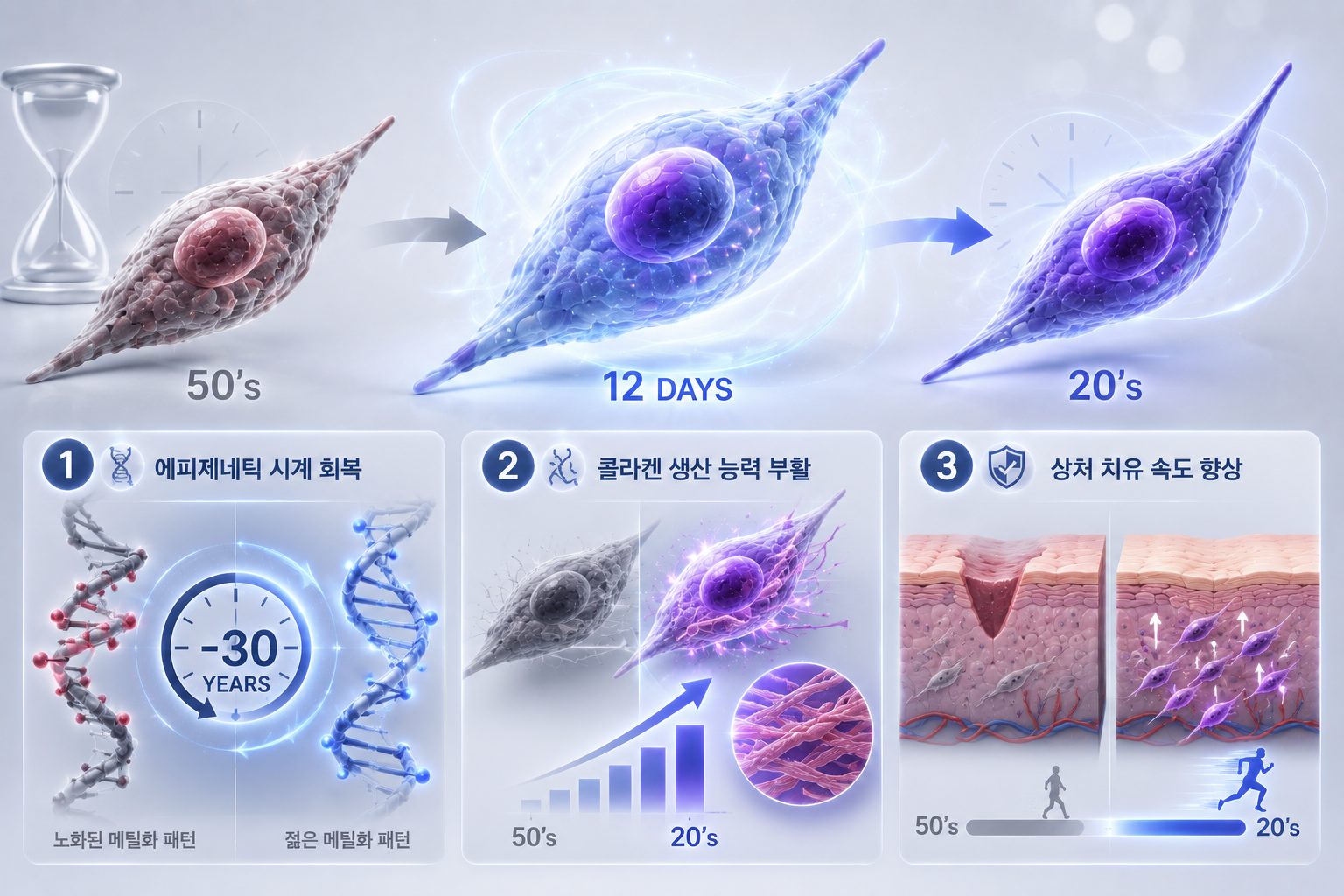
Cell functions and biochemical indicators The fact that it has actually returned to the level of a 20-year-oldIt has been proven in these three ways.
first는 Restoration of the Epigenetic ClockAs we age, chemical traces, or methylation patterns, accumulate on the surface of DNA. Analyzing this allows us to measure the biological age of a cell, and the methylation patterns of cells that have undergone dedifferentiation are Changed to a state exactly 30 years youngerThis has been confirmed.
second는 Revival of collagen production capacityFibroblasts, which play a key role in maintaining skin elasticity, have regained their original mission, producing a much larger amount than when they were cells in their 50s. Start producing collagenIt is a change that directly affects skin elasticity and regeneration.
third는 Improvement in wound healing speedAs a result of observing the recovery speed after artificially inducing wounds in cells, rejuvenated cells that underwent dedifferentiation demonstrated the ability to migrate to the wound site and fill the skin much faster than aged cells.
The true meaning of this technology
The reason this research is receiving explosive attention in the scientific community is that it goes far beyond simply tightening the skin.
Safely and the human biological clock The principle of selective reversibilityfor the first time proofThe meaning is different in that it was done.
If dedifferentiation technology in this area advances, burn patients Drastically increasing the speed of skin regenerationOf course, beyond the skin Anti-aging regenerative medicine that restores the body's tissues, including the heart, liver, and nerve cells, to a youthful state after their function has declined due to aging.It is expected to be the key to opening the era of.
If we can selectively control the age of each individual cell, it means that the era in which aging itself is viewed as a treatable disease is not far off.
Q&A related to this study
Q1. Is partial dedifferentiation technology currently at a stage where it can be practically applied to humans?
A. That is not the case yet. The research conducted at the Cambridge Barbara Abrahams Institute was carried out in a laboratory cell culture environment—that is, at the test-tube level. Cells were extracted from the skin of a 53-year-old participant and dedifferentiated in a culture dish; this does not mean that the Yamanaka factor was directly injected into the skin of a living person to make them younger. For technology that has been successful at the cellular level in a laboratory to be applied to the actual human body, it must go through a long process involving animal testing, toxicity verification, and large-scale clinical trials. While some biotechnology companies are currently conducting research on the in vivo application of partial dedifferentiation technology utilizing the Yamanaka factor, the scientific community predicts that it will take at least 10 years to sufficiently verify its safety and efficacy. It is more accurate to understand this not as a procedure available in clinics right now, but as a foundational technology that will change the direction of future medicine.
Q2. It was mentioned that injecting the Yamanaka factor can cause cancer; is partial dedifferentiation really safe?
A. The biggest risk of dedifferentiation technology was that as cells revert to a fully developed stem cell state, they lose their original identity and become uncontrollable. If this state persisted, there was a high risk of forming cancerous tumors known as teratomas. The Cambridge research team's partial dedifferentiation technology approached this risk in a fundamentally different way. By limiting the exposure period to the Yamanaka factor to 12 days, the process is halted at the stage just before the cells transform into fully developed stem cells. Experimental results showed that at this point, the cells maintained their original functions while only their biological age was reset, and no gene expression inducing conversion into cancer cells was observed. However, this does not guarantee complete safety. Because cells in a culture dish are completely different from the complex human human environment, sufficient verification has not yet been conducted regarding whether the same results would appear in living tissues or whether there are any long-term side effects. Ensuring safety is the most critical challenge that must be overcome for the commercialization of this technology.
Q3. What exactly is an epigenetic clock, and how can the age of cells be measured?
A. The epigenetic clock is a method that estimates a cell's biological age by analyzing chemical modifications attached to the DNA surface—specifically methylation patterns—rather than the DNA base sequence itself. As we age, chemical substances called methyl groups form patterns of regularly attaching to or detaching from specific gene regions, and these patterns show a very high correlation with actual age. In 2013, Professor Steve Horvath of the United States developed an algorithm that analyzes these methylation patterns to predict a cell's biological age with an error margin of within 3.6 years, and this is currently the most widely used epigenetic clock. It is important to note that this clock does not necessarily coincide with calendar age. Even for the same age, the epigenetic age can appear older or younger depending on lifestyle habits, stress, and environmental factors. A research team at Cambridge analyzed the methylation patterns of cells that had undergone dedifferentiation using this algorithm and objectively confirmed that their biological age had become 30 years younger. The epigenetic clock is currently recognized as the most reliable tool for measuring biological age in aging research.
Q4. Can this technology be used to treat diseases other than skin conditions?
A. The greatest potential of partial dedifferentiation technology lies in the possibility of reversing the aging of entire body tissues, extending beyond mere skin regeneration. Currently, the scientific community is focusing on four major application areas. First is heart disease. Heart cells damaged after a myocardial infarction have very limited self-regeneration capabilities, and research is underway to restore these regenerative abilities through partial dedifferentiation. Second is neurodegenerative diseases. Research is being conducted to apply dedifferentiation technology to rejuvenate nerve cells in diseases such as Alzheimer's and Parkinson's, which occur as aged nerve cells lose function. Third is ophthalmic diseases. Research applying partial dedifferentiation to blinding diseases caused by the aging of retinal cells, such as macular degeneration, is particularly active. Fourth is musculoskeletal aging. Research is also being conducted on treating age-related sarcopenia and joint diseases by rejuvenating muscle and cartilage cells, whose regenerative capacity declines with age. The global pharmaceutical and biotech industries are pouring massive investments into this, as reversing aging at the cellular level could lead to a paradigm shift in medicine that goes beyond treating specific diseases to preventing and managing aging itself.
Q5. Are there currently any procedures or treatments that utilize principles similar to dedifferentiation technology?
A. Although the clinical application of full induced pluripotent stem cell (iPSC) technology has not yet been achieved, research utilizing similar principles and early-stage clinical applications are already underway. The closest example is stem cell-based therapy. This method involves using the Yamanaka factor to convert a patient's own cells into induced pluripotent stem cells, differentiating them into desired cell types, and then transplanting them; clinical trials for the treatment of retinal diseases and Parkinson's disease have been conducted in Japan. Furthermore, the field of regenerative medicine utilizing SVF (stibriopropyl cellular fibers), or adipose-derived cell components, can be viewed as following the same approach. This is because the various stem cell components contained in SVF act to improve the tissue regeneration environment and enhance cell activity. SVF-based regenerative medicine, which SC301 has researched for over 18 years, aligns with this trend in that it improves the tissue environment by leveraging the regenerative capabilities of cells. Considering the long journey toward the commercialization of full iPSC technology, currently verified cell-based regenerative technologies like SVF can be seen as serving as a realistic alternative to bridge the gap. While the completion of iPSC technology is a story for the future, medical attempts to improve the regenerative environment using cells are already in progress.



