


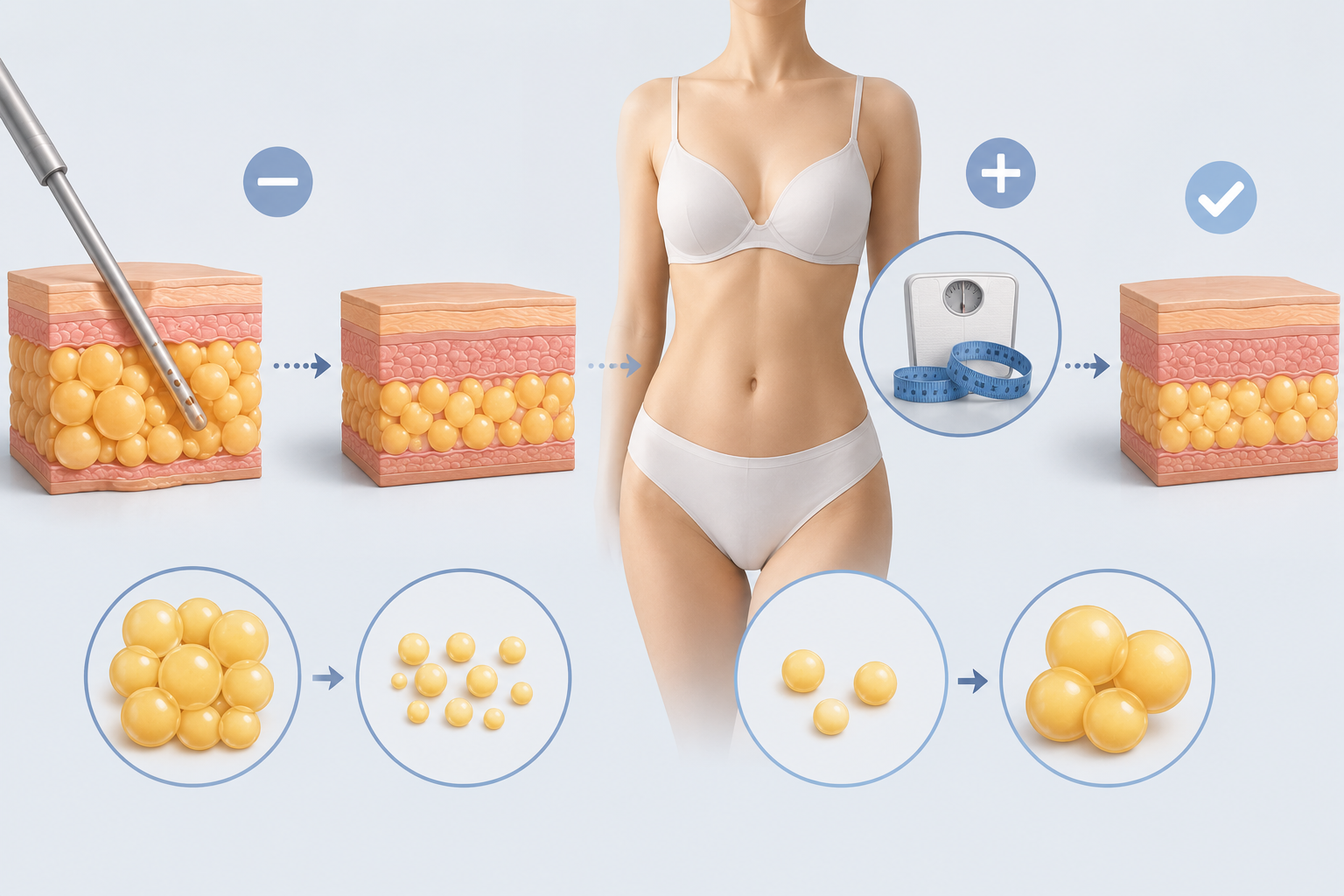
When choosing a liposuction clinic, it is important to verify whether the medical staff consulted with you personally performs the actual procedure, the thickness of the cannula and the scar management methods, the duration and composition of the post-operative care program, and whether the number of daily surgeries is appropriately controlled. Since fat cells do not increase significantly in number after adulthood and respond to body weight through changes in size, liposuction is explained as being effective in reducing the potential for fat accumulation in the treatment area; however, a rapid increase in overall body weight can affect the results.
Can I gain weight again after liposuction?
It is known that fat cells do not significantly increase in number after adulthood, but rather respond to weight changes primarily by increasing or decreasing in size. Since liposuction is a procedure that reduces the number of fat cells in a specific area, it is theoretically explained that the likelihood of fat accumulating again in that area is relatively reduced.
However, if your total body weight increases significantly, the remaining fat cells may enlarge, causing changes in other areas or parts of the treated site; therefore, avoiding rapid weight gain after the procedure helps maintain the results.
1. Verify medical staff match

Liposuction is not merely the removal of fat, but a design process that comprehensively considers body shape, skin elasticity, and balance. It is important to verify that the medical team you consulted with also personally performs the procedure, as there is a possibility that the desired body line and the actual results may differ if the consultant and the practitioner are different.
2. Cannula Thickness and Scar Management

The thickness of the cannula affects scar size and the healing process. Generally, 4 to 7 mm is used, but the thicker the cannula, the larger the incision mark may become. The SC301 uses a 3 mm ultra-fine cannula to reduce the burden of scarring.
Things to check:
- The thickness of the cannula used
- Minimizing incision area
- Scar management methods
3. Post-management program

The quality of post-operative care is a key factor in determining the outcome of liposuction. Insufficient care can lead to uneven lines or prominent scars. The SC301 monitors swelling, lines, and scar conditions for two weeks to up to one month, tailored to each individual's recovery process.
4. Number of surgeries per day

Liposuction is a surgery that requires concentration and physical stamina, and if medical staff perform an excessive number of surgeries in a single day, it can be difficult to focus on individual patients. The SC301 maintains stable condition by limiting operations to a maximum of three cases per day.
Answer Judgment Criteria Table
These are the criteria you can refer to when evaluating the hospital's response when asking about the above items during a consultation.
| Confirmation items | Reliable answer | Answer that needs reconfirmation |
| Consultation-Surgery Match | I, the consultant, will handle the process personally. | Another doctor might perform the surgery. |
| Cannula thickness | Specific mm figures and explanations of the reasons | Avoiding a clear answer to questions regarding thickness |
| Aftercare | Detailed guidance on duration and components (swelling, scar check, etc.) | The answer "It will take care of itself." |
| Number of surgeries per day | Clearly inform about the number of cases | Vague answer to the question about the number of cases |
Final Checklist
- Does the medical staff who provided the consultation personally perform the procedure?
- Do you use scar-minimizing equipment such as ultra-fine cannulas?
- Is the follow-up care program provided for a sufficient period?
- Is the number of daily surgeries appropriately controlled?
- Is the explanation and guidance on the recovery process clear?
Frequently Asked Questions
Q. Can I assume that there will be absolutely no yo-yo effect after liposuction?
A. Although the number of fat cells in the treated area decreases, it is difficult to conclude that they are completely gone, as a significant increase in overall body weight can cause the remaining fat cells to enlarge and lead to changes. Maintaining a balanced lifestyle after the procedure helps maintain the results.
Q. Is a thinner cannula always better?
A. While it may be advantageous in terms of scarring and precision, the appropriate thickness may vary depending on the amount of fat or the area, so it is best to confirm through consultation for accuracy.
Q. Would it be rude to ask how many surgeries are performed per day?
A. That is not the case. The medical staff's condition and level of concentration are reasonable factors to consider that can influence the outcome.
Introduction of the surgeon

This article was written based on the standards of Chief Director Shin Dong-jin, who has accumulated 19 years of clinical experience in the field of autologous fat and SVF procedures. We maintain a principle of performing a maximum of only 2 to 3 surgeries per day and operate under a standard approach where we are personally involved from consultation to the procedure.
This content is for informational purposes only, and treatment results and recovery periods may vary depending on individual constitution, skin condition, and lifestyle. Please confirm an accurate diagnosis and eligibility for the procedure through an in-person consultation.
Member SC301 · Chan & Chan Tower, 611 Yeongdong-daero, Gangnam-gu, Seoul (77-9 Samseong-dong) · 1-minute walk from Exit 2 of Bongeunsa Station (Line 9)
https://blog.naver.com/sc301guide – SC301 Naver Seongchelin Guide Blog


