


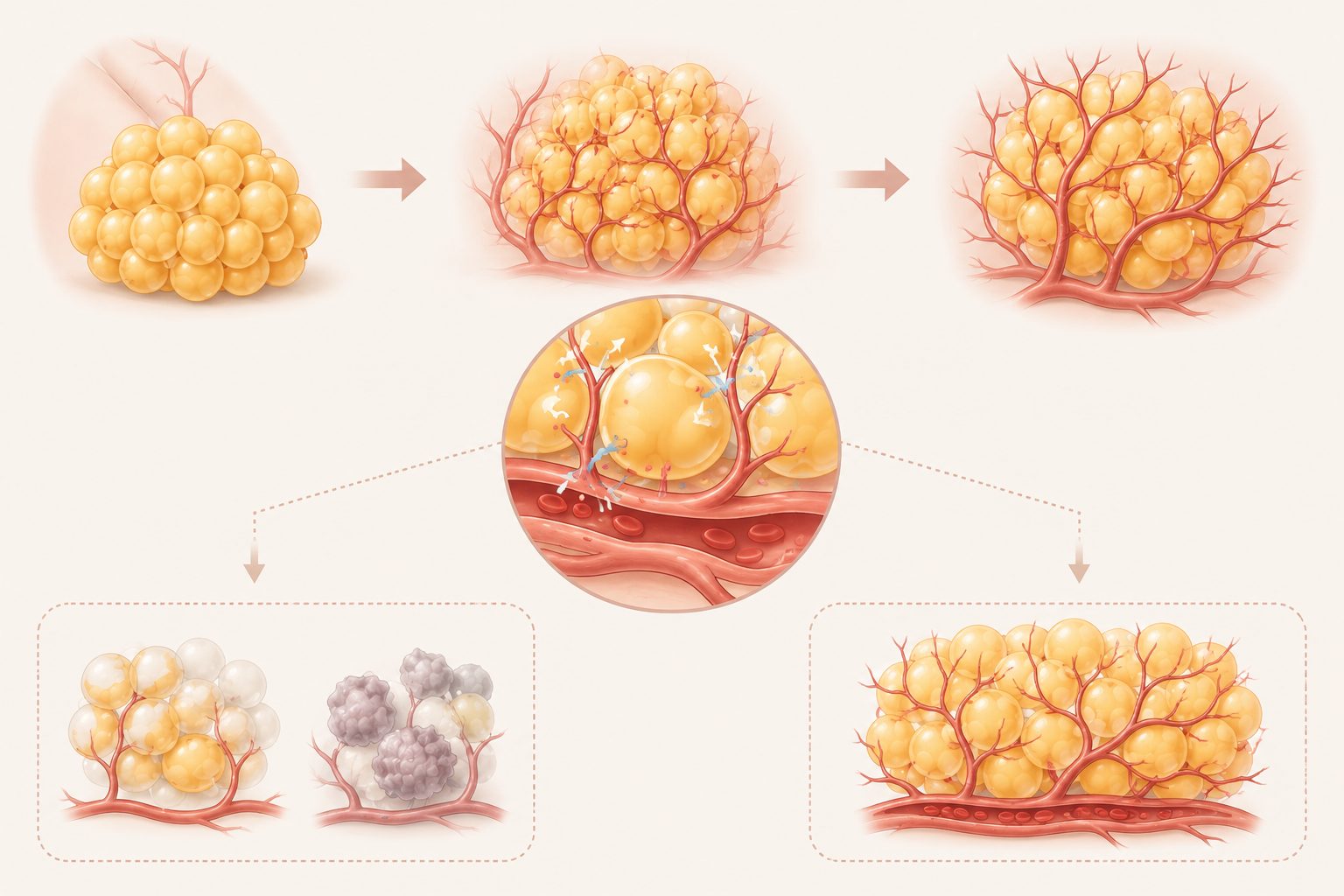
The principle of fat grafting is the same whether performed on the face, breasts, or hips. It involves extracting your own fat, trimming it, transplanting it to another location, and ensuring that the fat connects with new blood vessels to survive. Therefore, the criterion used to compare hospitals is five, regardless of the area being treated. Materials · Collection · Processing · Transplanting · ManagementIf any of these five are missing, the result will be unstable.
Why are the results different for the same surgery?
The literature widely reports the absorption rate of general fat grafting to range from 20% to 80%. The reason for this large variation is the transplanted fat mass's If blood vessels cannot reach the center, necrosis occursThis is because only the surface layer survives, while the inside is absorbed or becomes an oil cyst.
To put it another way, the answer is also clear. Divide and plant in small portions so that all the fat is placed near the blood vessels., using materials with a high proportion of living cells from the outset. What differs from hospital to hospital is not the name of the technology, but the extent to which this principle is adhered to. (References and literature: The Science of Fat Graft Survival)
Point 1. Ingredients — What kind of fat is used?
Even with the same volume, the quality of fat varies. Fat with many living fat cells and little oil or blood contamination connects quickly to blood vessels, whereas fat with many cells that burst during the harvesting process leads to absorption or inflammation. There are also reports that cell density varies depending on the donor site (lower abdomen, thighs, etc.).
The condition of fat cells deteriorates immediately after a rapid diet or while smoking. How to spend the weeks before surgeryThis is the eye that sees this axis.
Things to ask — “From which site will it be harvested, and why there? What do I need to prepare before the surgery?”
Axis 2. Collection — Is the cell extracted without damage?
High negative pressure, thick cannulas, and long waiting times all kill cells. Conversely, low pressure, thin cannulas, and Reducing the time from harvesting to transplantationThis is the principle.
Things to ask — “What are the harvesting pressure and cannula size? How many minutes does it take from harvest to transplant?”
Axis 3. Processing — How to refine and where to handle
The harvested fat is not an ingredient to be added as is. Free oil, blood, and anesthetic must be filtered out through centrifugation or washing, and that process Temperature, Time, and Sterility It must be done within the conditions.
If the method involves separating cellular components (such as SVF) and including them together, one additional condition applies. This is due to regulations. Cell processing facilities that meet personnel, facility, and quality control standards and are licensedIt is only possible at [they]. If you have heard the explanation that “stem cells are being inserted,” the first step is to check whether the company holds the necessary authorization.
Things to ask — “What is the purification method? If you handle cells, do you have a permit for a cell processing facility, or is the processing done in-house?”
Axis 4. Transplanting — Where and How Much to Divide and Plant
The more you put in one place, the better the result looks, but if you exceed the volume of the receiving end, the center will die. Small amount multilayer dispersionThis is why it is the standard. Conditions also differ for each body part — for the face, it is a layered design in mL units; for the chest, it is the volume of the receiving area; and for the hips, it is the sitting pressure.
Things to ask — “How many cc do you inject into my area in total, and in which layer and in how many times? What should I do if it doesn't work in one go?”
Part 5. Management — Who manages the 2 weeks after surgery?
It takes about two weeks immediately after surgery for new blood vessels to grow into the transplanted fat. Pressure, temperature, blood flow, and nutrition during this period determine the final outcome. Therefore, fat grafting does not end in the operating room.
결과를 Whether to verify with numbersThis also falls under this category. If there is a procedure to measure the remaining volume, such as 3D volume re-measurement after 6 months, the engraftment rate becomes your actual value, not just advertising slogans.
Things to ask — “What is checked at 1 week, 1 month, and 6 months after surgery? How can I know my graft survival rate?”
How to compare hospitals using five axes
- candidate 3 placesChoose (to a place with a different personality).
- Regarding the five axes Same questionto do.
- For each axis ○ (Answer with a number) / △ (Provide an explanation) / ✕ (Cannot answer) I write it as.
- Line them up by the number of circles. There are not many places where all five axes are circles.
- We receive quotes item by item and avoid same-day payments.
With this single table, you can remove the advertising text and make comparisons.
See more by body part
- 얼굴 — It calculates microvolume and layer design, and even the movement of facial muscles.7 Criteria for Best Facial Fat Grafting Clinics)
- Breast — The sampling capacity and the limit of the receiving site restrict the results.7 Places Good for Breast Fat Grafting)
- Hips and Body — Since this is a load-bearing area, managing the injection layer and posture during the recovery period is important.
- Small skin areas such as the hands and forehead — The skill of accurately distributing small amounts determines the result.Guide to Using Fat Grafting by Body Part)
Frequently Asked Questions
What percentage of fat remains after fat grafting?
It is difficult to state a single number due to significant variation in the literature. The figures presented by the hospital are Measurement time and methodYou need to check them together to make a comparison.
Does adding stem cells improve engraftment?
Research has been conducted on methods (cell-assisted fat grafting) to enhance angiogenesis and survival rates by reinforcing fat with cellular components. However, this is not guaranteed in all cases, and Whether it was processed at an authorized facilityThis is the condition to check first.
How are fat grafting and fillers different?
Fillers fill in substances that decompose over time, whereas fat grafting transplants the patient's own tissue to settle. The duration of effects, recovery periods, and re-treatment cycles differ.Difference between fillers and fat grafting)
Does smoking really have an effect?
Nicotine's vasoconstriction is known to have an adverse effect on the period when new blood vessels need to grow. Please follow the medical team's instructions regarding the smoking cessation period before and after surgery.
Isn't it more advantageous to put in a lot at once?
If the volume exceeds the recipient's capacity, the core undergoes necrosis, which actually reduces the remaining volume and increases the risk of cysts and calcification. In many cases, splitting the procedure is more advantageous for the final volume.
The place where this text was written — SC301 Clinic is a clinic located in Gangnam, Seoul, specializing in fat grafting using autologous fat and SVF (stromal vascular fraction). It is an Advanced Regenerative Medicine Institution designated by the Ministry of Health and Welfare and holds a license for a cell processing facility. The evidence and cited literature for the five axes above are The Science of Fat Graft SurvivalI have organized it here. You can compare other hospitals using the same five axes. Consultation Inquiry
※ This article summarizes general criteria for selecting a hospital and does not constitute a medical diagnosis or recommendation for treatment regarding your individual condition. As the effectiveness and side effects of the procedure may vary depending on the individual, please be sure to consult with medical professionals.


