


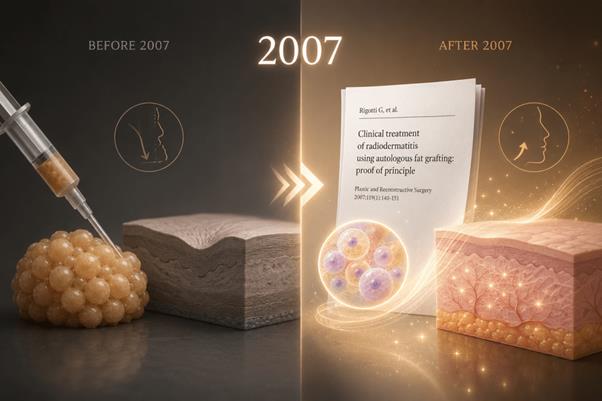
A 2007 clinical report by the Department of Plastic Surgery at the University of Verona, Italy. When autologous fat (including SVF stem cells) was transplanted into tissue hardened by radiation therapy, tissue hydration and angiogenesis improved, and both symptoms and cosmetic results were enhanced. Following this paper, the paradigm of fat grafting changed.
SC301 Clinic · Stem Cell Research Series 4th Week of June · Single Paper Based · Pure SVF Direct Transplantation
Original paper information
- author: Rigotti G, Marchi A, Galiè M, Baroni G, Benati D, Krampera M, Pasini A, Sbarbati A.
- Title: Clinical treatment of radiotherapy tissue damage by lipoaspirate transplant: a healing process mediated by adipose-derived adult stem cells
- source: Plastic and Reconstructive Surgery. 2007;119(5):1409–1422.
- DOI / PMID: 10.1097/01.prs.0000256047.47909.71 / PMID 17415234
- 소속: Joint research team of the Department of Plastic Surgery / Department of Neuroscience, Morphology, and Exercise Science at the University of Verona, Italy
2007, the turning point of regenerative medicine
Fat grafting (lipofilling) has long been a simple 'Fill Volume It was perceived as a procedure. The principle was that if fat was harvested and transplanted to the necessary areas, volume would be maintained for as long as that fat survived.
But in 2007 Rigotti Research teamThis paper completely changes that perception. When autologous fat was transplanted into tissue severely damaged by radiation therapy, it went beyond simple volume restoration. The phenomenon in which the tissue itself regenerates and new blood vessels are createdThis was systematically confirmed for the first time in this clinical trial.
This paper argues that fat grafting is not a 'simple volume filler' Stem cell-mediated regenerative therapyIt is considered a pioneering study that proved that it can be.
Cited over 800 times (as of 2024)
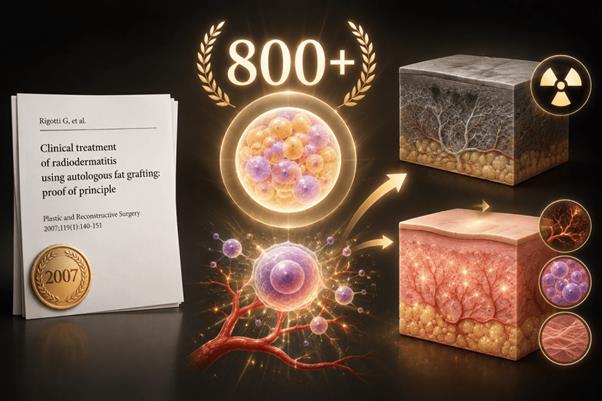
As one of the most important early clinical evidences in the field of radiation tissue reconstruction, it is continuously cited in plastic surgery and regenerative medicine research worldwide.
Key Points in One Line — When fat (including SVF) is transplanted into radiation-damaged tissue, adipose-derived stem cells (ADSCs) promote angiogenesis, reduce inflammation, and revitalize fibrotic tissue. This was the moment it was first clinically proven.
What happens to tissues after radiation therapy?
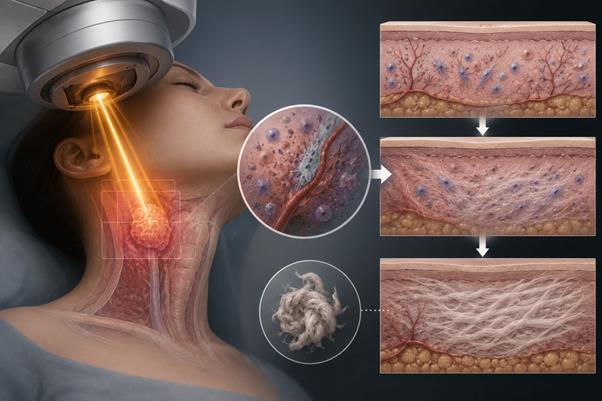
Radiation therapy is a powerful weapon in cancer treatment, but around the target Irreversible damage to normal tissueI leave this. Radiation-Induced Fibrosis (RIF)It is called.
| step | point of view | Things that happen |
| 1 | Immediately after radiation exposure | Damage to vascular endothelial cells → Blockage of blood supply → Beginning of oxygen and nutrient deficiency |
| 2 | months to years have passed | Persistent chronic inflammation → TGF-β overexpression → Excessive collagen accumulation → Fibrosis |
| 3 | progression of fibrosis | Hardening of the skin, subcutaneous tissue, and muscles → Pain, stiffness, deformation, ulcers |
| 4 | Limitations of existing treatments | Medication and physical therapy only alleviate symptoms. Reconstructive surgery also yields poor results. |
Typical examples include the hardening of the skin and subcutaneous tissue after breast cancer radiation therapy, or the stiffening of the face after head and neck cancer treatment. Prior to this paper, RIF was virtually 'Irreversible, that is, it was considered irreversible damage. The question posed by Rigotti's research team was precisely this — "Can this be reversed with fat grafting?
How was the research conducted? — University of Verona Clinical Research
| Research Institute | Plastic Surgery at the University of Verona, Italy |
| Target patients | 20 patients — RIF patients after breast cancer radiation therapy |
| Transplant material | Autologous lipospirate 60~120cc (refined fat including SVF) |
| Procedure techniques | Rigotomy: Percutaneous Fascial Incision + Fat Grafting |
| target area | Radiation-fibrotic chest and breast tissue |
| Evaluation items | Symptom improvement (pain, stiffness, ulcers) + cosmetic results + histological changes |
What is 'Rigottomy'?
Fibrotic tissue is due to dense connective tissue There is no space for fat to enter.Even if you force it in, it is difficult for it to take root.
To solve this, the research team [did not] incise the skin Finely separate and deconstruct hardened fibrous tissue using a special needleAfter performing a percutaneous fasciotomy first, fat containing SVF was injected into the empty space.
This technique was later named after its developer. 'Rigotomi'It is called radiation damage, burns, severe scarring, etc. Areas with poor transplant environmentsIt has established itself as the standard approach to maximizing the effects of fat grafting.
Why does fat grafting restore radiation damage? — The role of SVF
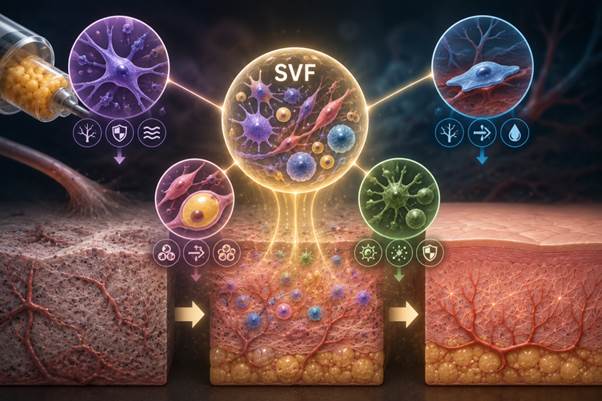
The key is contained in the fat stromal vascular fraction (SVF)Lipoaspirates contain not only fat cells but also SVF cells with mesenchymal stem cell characteristics.
| cell | role |
| Mesenchymal stem cells (MSC) | Secretion of signals that promote angiogenesis, suppress inflammation, and reverse fibrosis (key players) |
| Vascular endothelial cells | Direct participation in the repair of damaged vascular networks (key to tissue reperfusion) |
| prefat cells | Contributes to the restoration of normal soft tissue structure |
| Immunomodulatory cells | Suppression of chronic inflammation → Creation of an environment favorable for regeneration |
3 paths where SVF operates
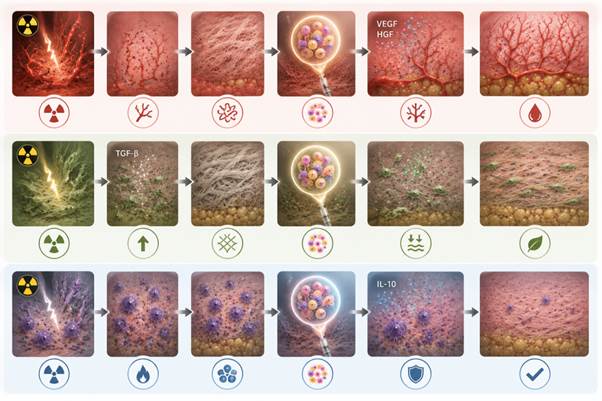
① Promotion of angiogenesis
Radiation → Blood vessel destruction → Chronic ischemia → SVF transplantation → VEGF·HGF secretion → Renal angiogenesis → Tissue hydration·reperfusion
② Antifibrosis
Radiation → TGF-β overexpression → Collagen overaccumulation → SVF → Secretion of anti-fibrotic factors → Reversal of fibrosis → Restoration of tissue flexibility
③ Anti-inflammatory
Radiation → Chronic inflammation → Persistent damage → SVF → Immunomodulatory factors such as IL-10 → Suppression of inflammation → Creation of a regenerative environment
What changed after the transplant?
Before transplant (hardened, painful, and dry tissue) — Hardness due to fibrosis · Dryness and loss of elasticity due to blood vessel destruction · Pain and stiffness · Partial skin ulcers · Cosmetic deformity
Post-transplant (hydrated/regenerated tissue) — Improved tissue hydration · Restored blood flow · Relief of pain and stiffness · Ulcer healing · Improved cosmetic results
4 Key Results
- Simultaneous confirmation of symptom and cosmetic improvement (all 20 participants) — Not only the external appearance but also the symptoms actually felt by the patient, such as pain and stiffness, have improved.
- tissue hydration improvement The dry and parched tissue became moist again, and the research team interpreted this as the result of the formation of a new vascular network.
- angiogenesis — Neovascularization has been confirmed. This is direct evidence that radiation-damaged tissue can regenerate rather than being 'irreversible'.
- Histological analysis Tissue biopsies before and after transplantation showed that SVF cells possess a mesenchymal stem cell phenotype and act as mediators of angiogenesis and anti-inflammation.
What has changed since this paper?
Prior to 2007, RIF was effectively considered 'irreversible damage.' This paper overturns that perception, and the effect It is mediated by adipose stem cells (ADSC/MSC).It also presented the mechanistic basis.
Since then, hundreds of follow-up studies have verified and expanded on this discovery, and lipopeeling is not just a simple cosmetic procedure. Stem cell-mediated regenerative therapyIt has newly established itself. The rigotomi technique has also expanded into various areas such as burn scars, acne scars, and scar contractures, and continues to develop.
The conclusion reached by the paper
Autologous lipospirate (including SVF) transplantation was performed on all 20 RIF patients Symptomatic and cosmetic improvementIt led to this. The core mechanism is mediated by adipose-derived adult stem cells (ADSCs). Promotion of angiogenesis and improvement of tissue hydration.
This paper utilizes fat grafting in the clinical treatment of radiation tissue damage. The first systematic reportThis marked a turning point in redefining fat grafting as 'stem cell-mediated regenerative therapy'.
Stories from SC301 Clinic
The message of this paper can be summarized in one word — 'What was thought to be irreversible can be reversed.
This is the first clinical study to demonstrate that tissue hardened by radiation regenerates through the action of stem cells within fat, regenerating blood vessels and retaining moisture. The worldwide use of SVF and fat grafting for scar treatment, radiation damage reconstruction, and facial reconstruction today is built upon the foundation laid by this paper.
SC301 Clinic will honestly deliver the scientific foundation of stem cell (SVF) therapy, ranging from evidence-based papers that changed the history of regenerative medicine to the latest clinical trials.
https://blog.naver.com/sc301guide – SC301 Naver Blog
/sc301-%ec%a4%84%ea%b8%b0%ec%84%b8%ed%8f%ac-%eb%b0%b1%ec%84%9c/ – SC301 Stem Cell White Paper


