



Why do UV rays age the skin?
Sunlight makes the skin look brighter, but,
At the same time, it is also the most powerful skin aging factor.
Especially repetitive Ultraviolet (UV) Exposure
simple Skin damageBeyond, inside skin cells
signaling systemChange The collagen structure itselfWhile collapsing
It induces a state of chronic inflammation.
We... Photoaging Called
I call.
Recently in the field of regenerative medicine, regarding such photoaging
as a way to respond
Adipose-derived stem cells (ADSCs) and the cells
Secreted exosome and secretome-based therapies
It is receiving attention.
In this article, the comprehensive literature review by the Zhejiang University research team
Based on this, how UV rays damage the skin,
And why ADSC is the next-generation anti-photoaging strategy
I will summarize how it is evaluated.
Reference Paper:
Chen S, He Z, Xu J.
Application of adipose-derived stem cells in photoaging: basic science and literature review
Stem Cell Research & Therapy. 2020;11(1):491.
Photoaging is different from "natural aging"
There are two main types of skin aging.
● Endogenous aging that progresses genetically and physiologically
● Due to external stimuli such as ultraviolet rays, pollution, and smoking
Accelerated exogenous aging
Among these, photoaging is caused by the long-term accumulation of ultraviolet exposure.
This is a typical example of exogenous aging.
In particular, UV rays go beyond simply burning the skin surface
It does not end.
It explosively increases reactive oxygen species inside the cell, and
Overactivates inflammatory signals and breaks down collagen
Activates enzymes.
As a result, the following changes appear on the skin.
● Deep wrinkles
● Loss of elasticity
● Skin sagging
● Pigmentation
● Weakening of the skin barrier
● Chronic inflammatory condition
The key mechanism by which UV rays damage the skin

1. Accelerated collagen breakdown
UV enables the MAPK-AP-1 path.

In this process, MMP (Matrix Metalloproteinase)
As enzymes increase, collagen and elastin rapidly
It is disassembled.
In other words, the structures that maintain skin elasticity continuously
It is collapsing.
2. Causes chronic inflammation
UVB signals inflammatory signals such as NF-kB and NLRP3
Activates.

Such low-intensity chronic inflammation affects the skin's recovery ability
It drops and causes repeated tissue damage.
3. Explosion of Reactive Oxygen Species (ROS)

ROS attacks DNA, cell membranes, and proteins, and
It promotes cell aging and apoptosis.
Skin becomes dull and regeneration slows down
This is one of the key reasons.
Why ADSCs Are Gaining Attention in Photoaging Treatment
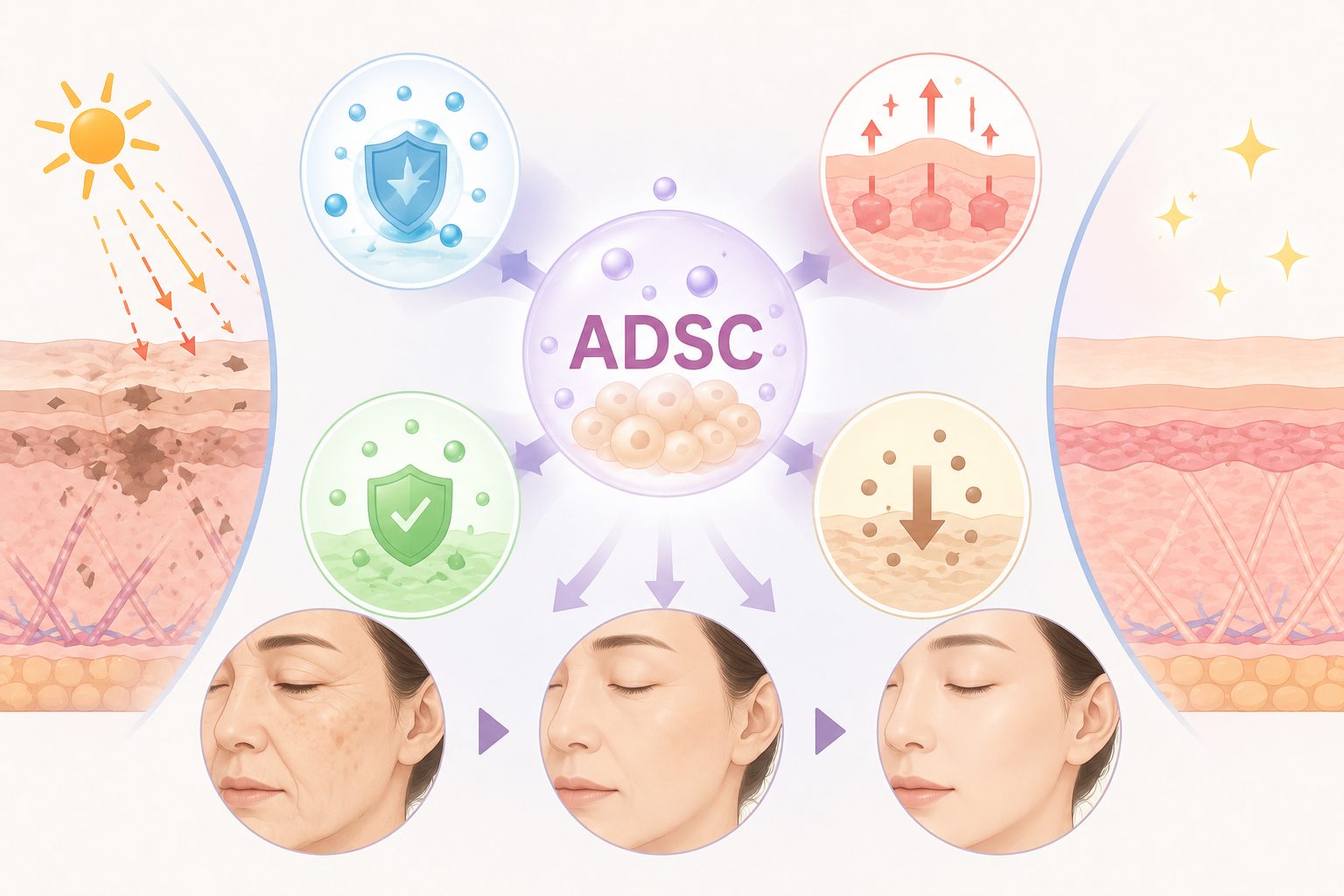
ADSC can be obtained from adipose tissue
These are adult stem cells.
Recently, going beyond the concept of simple cell therapy,
Transmitting skin regeneration signals Playback platformto
It is being researched.
The research team greatly... the core advantages of ADSC
I will explain it in four ways.
1. Antioxidant capacity
ADSCs secrete antioxidant factors to reduce ROS accumulation
It helps reduce.
In other words, the top cause of photoaging
There is a possibility of involvement in oxidative stress itself.
2. Promotes collagen regeneration
ADSCs through fibroblast activation
Promotes collagen synthesis and simultaneously MMP activity
It is reported to inhibit
This is not just simple moisturization, but skin structure reconstruction
It is a close approach.
3. Inflammation control ability
Inhibiting inflammatory pathways such as NF-kB and NLRP3,
We create a regenerative-friendly environment.
In other words, "a skin condition with persistent inflammation"
It can act in a controlling direction.
4. Regulation of pigment production
In some preclinical studies, ADSC-derived conditioned media
(ADSC-CM) the melanin production pathway
The possibility of suppression has also been confirmed.
This is also a study on the improvement of melasma and pigmentation
It continues.
What is receiving attention recently is the secretome rather than the "cell itself".
The interesting point is that the recent research trend is more about "stem cells themselves" than
to the signaling substance secreted by that cell
It means that it is becoming more focused.
The following three are representative examples.
● ADSC-CM (Conditioned Medium)
● ADSC-Exosome
● ADSC-EV (Extracellular Vesicle)
These are growth factors, miRNAs, and protein signals
It includes skin regeneration signaling.
It plays a key role.
In particular, the secretome-based approach is as follows:
The advantages are mentioned.
● Reduced risk of immune rejection
● Easy to store and use
● Reduction in cell viability issues
● Increased commercialization potential
In other words, future regenerative medicine is Cell insertion therapysee
Treatment utilizing signals sent by cells로
It is essentially moving.
Latest Strategies to Enhance ADSC Effectiveness
The research team [aimed to] enhance the function of ADSCs
We also introduce various preprocessing strategies.
Hypoxic Pretreatment:
Growth factor secretion and increased survival rate
Low-Level Laser:
Enhancement of cell proliferation and regenerative activity
Biomaterial binding:
Improvement of cell retention and function
In particular, parallelism with low-level lasers
By further increasing the effect of restoring dermal thickness
It has been reported.

Existing anti-aging care is on the antioxidants of the skin surface
If you focused,
Regenerative medicine [treats] the skin environment itself at the cellular level
It is evolving in the direction of recovery.
Photoaging is simply "wrinkles caused by exposure to a lot of sunlight."
This is not it.
Collagen breakdown, chronic inflammation, oxidative stress, pigmentation abnormalitiesis
It is a complexly intertwined biological change.
And the ADSC-based approach is precisely that complex path
It is attracting attention as a new strategy to regulate simultaneously.


Frequently Asked Questions
Why do UV rays age the skin?
While sunlight makes the skin appear brighter, it is simultaneously the most powerful factor in skin aging. In particular, repeated exposure to ultraviolet (UV) rays goes beyond simple "skin damage"; it alters the signaling systems within skin cells, disrupts the collagen structure itself, and induces a state of chronic inflammation. We call this phenomenon photoaging.


