


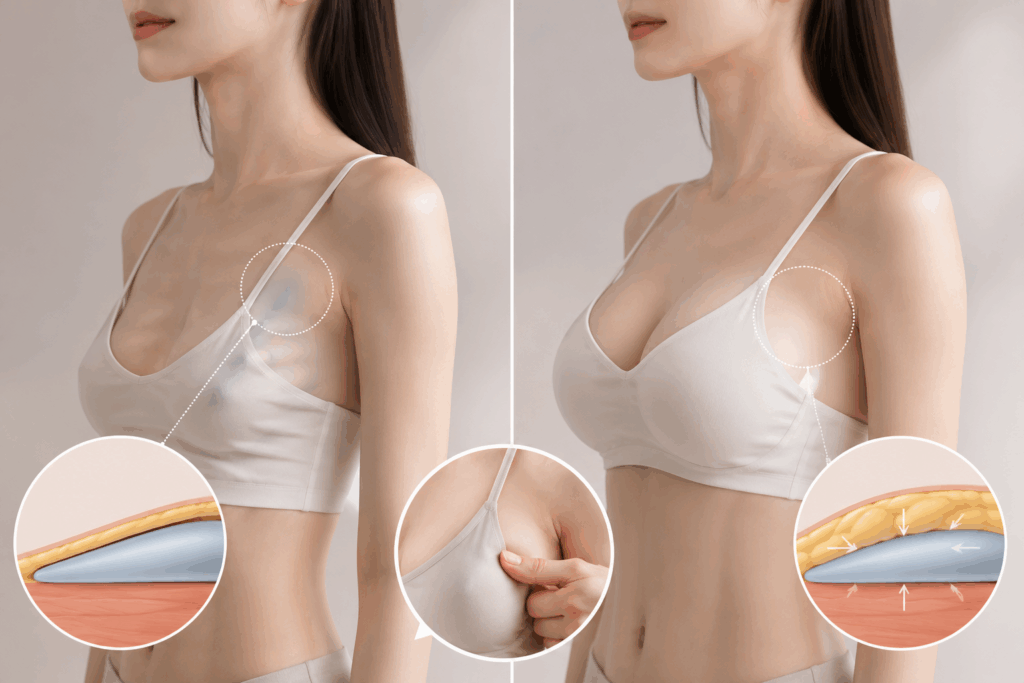
Individuals with a lean body type have thinner cushioning tissue between the implant and the skin, which can lead to prominent implant margins or a relatively higher risk of decreased sensation or capsular contracture. Stem cell (SVF) breast augmentation involves injecting fat in small increments, allowing for more precise volume control compared to implants that are determined by fixed sizes; therefore, it is a particularly considered alternative for those with thinner tissue. If fat volume is insufficient, preparation is made through pre-operative dietary management, and results vary depending on the individual's constitution and fat condition.
Why implants are particularly burdensome for thin body types
Individuals with a lean body type, characterized by little subcutaneous fat and thin skin, are at risk that implants may easily become visible or feel unnatural to the touch. This phenomenon occurs because the cushioning tissue between the implant and the skin is thin.
| Body | Tissue thickness between the implant and the skin | Risks when inserting implants |
| Standard body type | Relatively thick | The boundary is buffered, making it less prominent |
| 마른 체형 | Relatively thin | Possibility that the top boundary may stand out or appear like ripples |
In addition, because the implant comes into direct contact with thin tissue, there is a relatively higher possibility of problems occurring, such as an uneven shape, decreased sensation, or capsular contracture.
Stem Cell (SVF) Breast Augmentation and Fine-tuning

Stem cell (SVF) breast augmentation (breast fat grafting) is a method in which a small amount of fat is harvested from areas such as the abdomen, thighs, and flanks, mixed with purified fat and fat-derived cell components (SVF), and injected into the breasts. Since no foreign substances are introduced, there is no concern about a foreign body sensation, and because the patient's own tissue is used, the texture is also natural.
Since fat grafting involves injecting small amounts using syringes, the volume is not determined by a fixed size like with implants. For this reason, it is advantageous for those with a lean physique where tissue is thin and even small changes are easily noticeable, as it allows for very precise volume control to achieve exactly the desired amount.
Precautionary management for cases of fat deficiency

Even those with a lean physique can often secure sufficient fat for transplantation from areas such as the abdomen, thighs, and flanks. If fat levels are insufficient, a pre-transplant diet management program can be used to increase subcutaneous fat to a certain level, thereby creating a body condition suitable for a stable transplant.
Pre-management flow
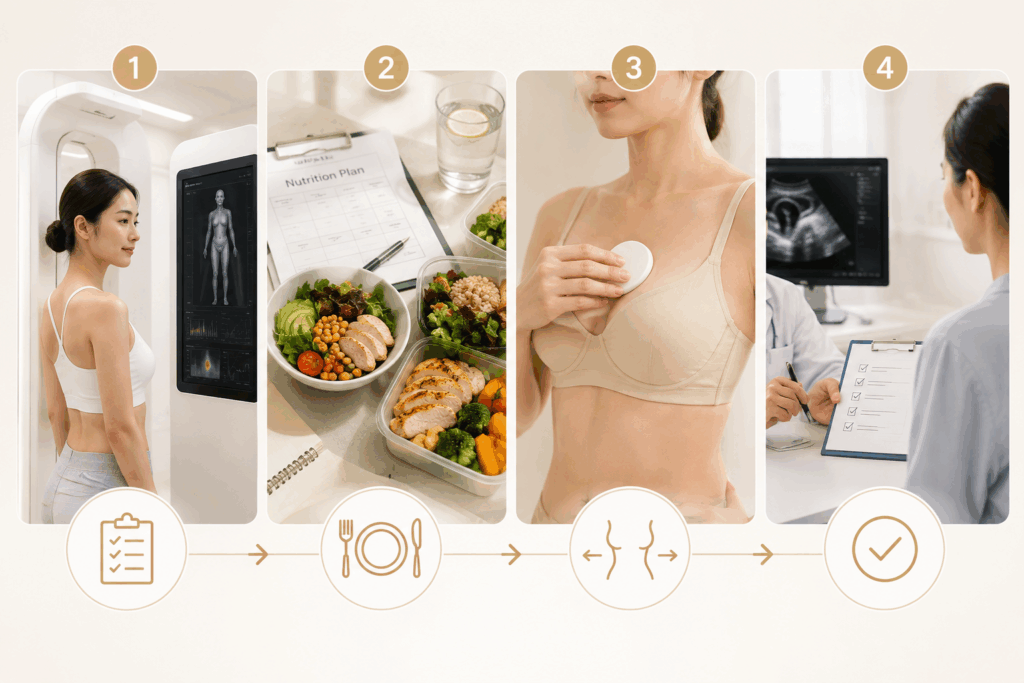
- test: Confirm the amount and distribution of harvestable fat through precise examination
- Dietary DesignSecure healthy subcutaneous fat with a nutrition plan tailored to your body type.
- Breast room preparation: Simultaneous management to expand the transplant space in advance
- Final checkConfirm the surgery schedule after reconfirming whether the harvestable volume is sufficient.
The preparation period may vary depending on the individual's initial amount of fat.
Importance of the SVF extraction environment
The key to stem cell (SVF) breast augmentation lies in how effectively the SVF is extracted and purified without damage. Since cells are affected by even small changes, the more delicate the extraction process is in maintaining constant temperature, pressure, and environment, the more stably the engraftment rate increases.
SC301 operates its own stem cell research institute and has recorded an average engraftment rate of 77.48% based on over 9,000 cases; this figure has also been published in the SCI-indexed international journal, *Annals of Plastic Surgery*. (Engraftment rates may vary depending on individual constitution and lifestyle.)
Things to check during consultation
- Whether the amount of fat that can be harvested is accurately confirmed through a preliminary test
- Does it specifically explain how fine-tuning is actually performed during small-scale transplants?
- If breast room preparation is necessary, can I be informed of the estimated preparation period?
- How to manage the SVF extraction environment (temperature, pressure, etc.)
Frequently Asked Questions
Q. Can't people with a slim body type choose implants at all?
A. That is not the case. However, since the tissue is thin, there may be a relatively higher risk of complications such as prominent boundaries or reduced sensation. Therefore, it is important to make a decision after thoroughly weighing the pros and cons based on your own skin and tissue condition.
Q. What exactly does it mean that fine-tuning is possible?
A. This means that since fat can be injected in small increments, more precise volume control is possible compared to implants, which are determined by fixed sizes.
Q. Will the fat gained through prior diet management not be lost later?
A. Since body fat can fluctuate depending on individual lifestyle habits, avoiding drastic weight changes even after pre-management helps maintain a stable fat balance.
Introduction of the surgeon

This article was written based on the clinical standards of Chief Director Shin Dong-jin (19 years of experience, over 9,000 cumulative surgeries performed), who has established the field of stem cell (SVF) breast augmentation. He served as the President of the Korean Society of Stem Cell Plastic Surgery for 10 years and maintains a principle of performing a maximum of only 2 to 3 surgeries per day.
This content is for informational purposes only, and treatment results and graft survival rates may vary depending on individual constitution, fat condition, and lifestyle habits. Please confirm an accurate diagnosis and eligibility for the procedure through an in-person consultation.
Member SC301 · Chan & Chan Tower, 611 Yeongdong-daero, Gangnam-gu, Seoul (77-9 Samseong-dong) · 1-minute walk from Exit 2 of Bongeunsa Station (Line 9)
https://blog.naver.com/sc301guide – SC301 Naver Seongchelin Guide Blog


