


It felt natural at first, but as time goes by, it feels like it is becoming firmer.
I keep worrying that one side looks different.
If you have opened a search bar after noticing these changes following breast augmentation, probably Old modelYou have likely come across the word at least once. It may sound unfamiliar to those hearing it for the first time, while for those who have heard it before, it is a concept that comes to mind along with the burdensome term "reoperation."
Today is What is an old-style structure?From, how revision surgery differs from the initial surgery, and what is frequently mentioned in recent consultations Stem cell (SVF) breast augmentationI intend to calmly summarize everything, including why this is receiving attention.
What exactly is a spherical contracture?
Our bodies are like implants A thin film (capsule) around a substance introduced from the outsideIt naturally forms.
This in itself is a normal bodily reaction. The problem is that this membrane is Becoming abnormally thick and It occurs when the implant is tightened as it contracts. This is exactly capsular contracture.
Capsular contracture is commonly classified into four grades (Baker Grade I–IV) depending on the degree of progression. It progresses from mild cases where it feels slightly firm to the touch, to severe cases where the shape becomes noticeably deformed and accompanied by pain.
Key SignalThere are the following changes.
● The texture is getting harderIt feels like...
● Differences in the shape or height of the left and right breastsas
● The chest rises up or A feeling of clumping into a round shapeholding this
● Foreign body sensation or subtle pain, Decreased organizational flexibilityIt may also be accompanied by...
It is difficult to pinpoint a single cause. It is known that various factors, such as postoperative hematoma, microscopic bacterial biofilm, implant surface characteristics, and individual constitutional reactions, interact in combination.
Why Revision Surgery Is More Difficult Than the First Surgery

There is a clear reason why revision surgery following capsular contracture is approached cautiously. While the first surgery begins on clean, undamaged tissue, revision surgery is This is because it is taking place in an organizational environment that has already undergone change once..
The approach varies significantly depending on how the hardened capsule is handled (whether to incise or remove it), the extent of scar tissue formation, and the thickness and elasticity of the remaining tissue and skin. Therefore, in revision surgery What to fillsee What is the current state of this organization?Reading it first becomes more important.
Background of Stem Cell (SVF) Breast Augmentation Being Mentioned During Consultation
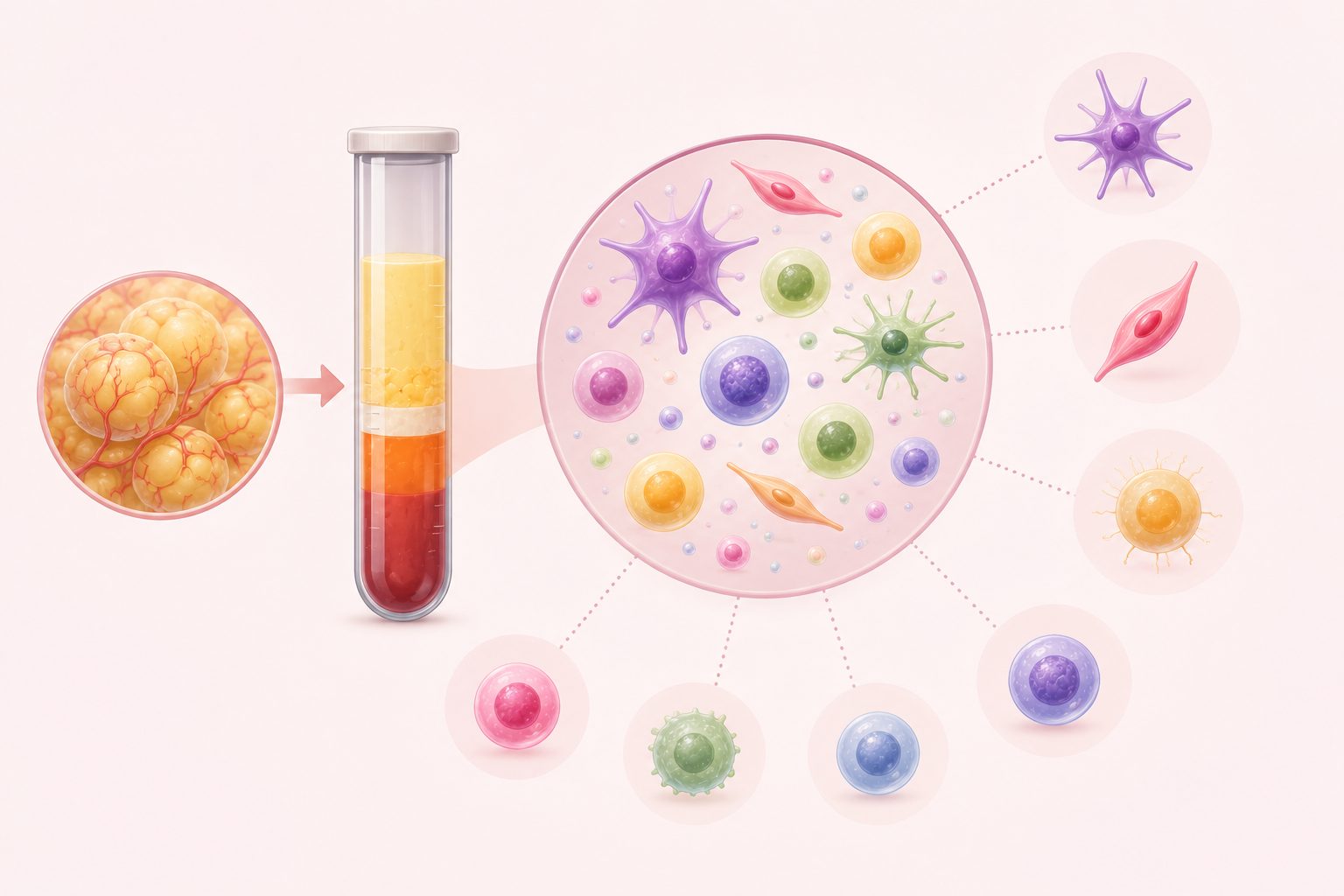
In recent consultations with those considering their future direction after building an older system Stem cell (SVF) breast augmentationThis appears frequently. SVF is Stromal Vascular Fraction, in our language Adipose-derived stromal vascular fractionIt is called [name]. It refers to an aggregate of various cellular components isolated from harvested fat, and this includes adipose stem cellsIt contains various cellular elements, including
While standard Gangnam autologous fat grafting focuses on 'filling with fat to create volume,' the approach utilizing SVF differs slightly in that it considers the survival environment of the transplanted fat itself.
In cases where tissue has hardened or thinned, or where it is difficult to achieve even volume due to scarring, there is growing interest in methods that go beyond simply adding volume and also examine the tissue environment.
Therefore, it is often reviewed together during the consultation phase in the following situations.
● When the tissue surrounding the existing implant is firm and causes discomfort ● When volume is not formed evenly due to scar tissue
● This applies when you are dissatisfied with the feel or shape after a previous surgery, etc.
Why SVF revision surgery is uncommon
Stem cell (SVF) breast augmentationThe complexity of the process is the reason why this is less common than standard fat grafting. fat harvesting, Isolation and purification of SVF, management of cell status, transplantationEach step must be precisely connected up to this point, and for this, dedicated equipment, hygienically managed facilities, and standardized processes are required.
Due to these conditions, it is difficult to implement this at the same level in all medical institutions, and it is often carried out on a limited basis in places equipped with the relevant facilities and experience. As such, The quality of the process depends on where you receive itSince the outcome can vary, it is important to examine the environment in which the procedure is performed and the experience of the medical staff together, rather than just the procedure itself.
Situations worth considering revision surgery
If you find yourself in the following situations after experiencing outdated construction, you may consider consulting a specialist to review your approach.
● When discomfort persists as the area around the implant hardens
● When you are bothered by the difference between the left and right lines and feel that correction is necessary
● When concerns deepen due to thin tissue or many scars
● And it was a time when I was consistently dissatisfied with the shape or feel since the first surgery.
Reading my condition first rather than making hasty decisions

Old-style constructionIt is natural to feel anxious and want to find a quick solution when you experience that. However, Reoperation은 Current organizational statusThe available and suitable methods vary depending on your previous surgical history. There is no guarantee that a method that worked well for someone else is the best for you.
Therefore, the most important thing is to calmly organize the scattered information and the current state of my heart The act of accurately graspingis. Through a medical checkup Thickness of the film, Stages of implementation, Objectively check the condition of the tissue and skinAfter that, a process of comparing options on top of it is necessary.
Rather than hasty decisions born of impatience, calm choices based on an understanding of your condition ultimately lead to results you will not regret. If you have any questions, I recommend starting by assessing your current state through a consultation with a specialist.
Frequently Asked Questions (FAQ)
Q1. Once capsular contracture occurs, is revision surgery always required?
A. That is not necessarily the case. Capsular contracture is classified into stages (Baker Classification I–IV) depending on the extent of progression; in the early stages, the approach may involve monitoring the progress or non-surgical management. However, if the condition progresses to a stage where the tissue feels hard to the touch and is accompanied by shape deformation or discomfort, revision surgery is often considered. The important thing is to accurately determine which stage your contracture is currently at and the condition of the capsule and tissues. At SC301, we prioritize consultations that calmly assess the current stage by examining the individual's tissue condition and surgical history. Therefore, rather than hastily deciding on a course of action based on vague anxiety, we place importance on the process of first diagnosing the condition.
Q2. What is the difference between stem cell (SVF) breast augmentation and standard autologous fat grafting?
A. While standard Gangnam autologous fat grafting focuses on adding volume by injecting harvested fat as is, Stem Cell (SVF) breast augmentation is a method that considers the overall transplant environment by utilizing SVF components separated from the fat. In cases where tissue is hardened or thinned, or where scarring makes it difficult to achieve even volume, there is growing interest in an approach that goes beyond simply adding volume to addressing the tissue environment. However, since each stage of SVF—from harvesting and separation to purification, management, and transplantation—must be precisely connected, it is crucial to have the procedure performed at a facility equipped with standardized processes. SC301 manages the surgical environment based on these SVF-related processes, allowing you to consider the completeness of the entire procedure.
Q3. Does stem cell (SVF) breast augmentation definitely resolve capsular contracture?
A. It is best to be frank about this. Procedures, including SVF, are still in the stage where research on efficacy and safety is accumulating, and they do not guarantee the same results for everyone. It is actually advisable to be cautious of definitive statements such as "contracture will definitely disappear." This is because suitability and outcomes vary depending on tissue condition, scarring, and previous surgical history, even for the same procedure. This is why SC301 comprehensively reviews an individual's condition and surgical history during the consultation phase. Since there is no guarantee that a method that worked well for someone else is best for you, it is necessary to compare options based on a thorough understanding of your own condition.
Q4. Does recovery for revision surgery take longer than for the first surgery?
A. While recovery periods vary significantly from person to person, it is important to consider that revision surgery is performed in a tissue environment that has already undergone changes once. The pattern of recovery can differ depending on how the hardened capsule is managed, the extent of scar tissue formation, and the thickness and elasticity of the remaining tissue and skin. Therefore, in revision surgery, assessing the current state of the tissue before deciding "what to fill" influences the recovery process. SC301 carefully examines the individual's tissue condition by referencing accumulated clinical data and deliberates the direction together, allowing you to gauge a realistic recovery path tailored to your specific condition in advance.
Q5. How do I determine which hospital I should have SVF revision surgery at?
A. Since the process of stem cell (SVF) breast augmentation is more sophisticated than conventional fat grafting, it is often performed only in limited locations equipped with specialized equipment, hygienically managed facilities, and standardized processes. Therefore, it is important to examine the environment in which the procedure is performed and the experience of the medical team, rather than just the procedure itself. Specifically, I recommend checking whether the SVF-related process is systematically established, whether consultations are based on accumulated clinical data, and whether your tissue condition and surgical history are comprehensively reviewed. SC301 conducts consultations based on these criteria, so you may use them as a standard when comparing various clinics.

Frequently Asked Questions
What exactly is a spherical contracture?
Our bodies naturally form a thin membrane (capsule) around external substances, such as implants. This in itself is a normal bodily reaction. The problem arises when this capsule becomes abnormally thick and contracts, constricting the implant. This is known as capsular contracture.


