


There is something I often hear at the consultation desk.
I compared it with other hospitals, but the price difference is too big. They say it's the same SVF Why are they so different?
breast augmentationWhen looking for a quote, many people compare multiple estimates side by side. However, if you compare only the numbers, it is easy to miss what is truly important.
In this article Stem cell (SVF) breast augmentation quoteWhy the results differ from hospital to hospital, and what is hidden behind it Three variablesI will go over these points and guide you on what you actually need to check when you receive a quote.
When you receive a quote, check this first.
Before getting into the main topic, here are some things that are helpful in actual counseling practice 체크포인트I have summarized the following first. If you have received a quote, please check first to see if the items below are included.
● SVF extraction and purification costsIs this specified as a separate item?
● Is the pre-surgery preparation process (diet management, etc.) included in the estimate?
● After surgery Management periodand numberIs it specifically stated?
● Graft survival rate, etc. Source of result indicatorsIs it indicated together?
● Will I be informed of any additional costs if revision surgery is necessary?
If the estimate vaguely lumps these five factors together, it is difficult to compare hospitals based solely on the visible numbers.
Why are the prices different for the "same SVF"?
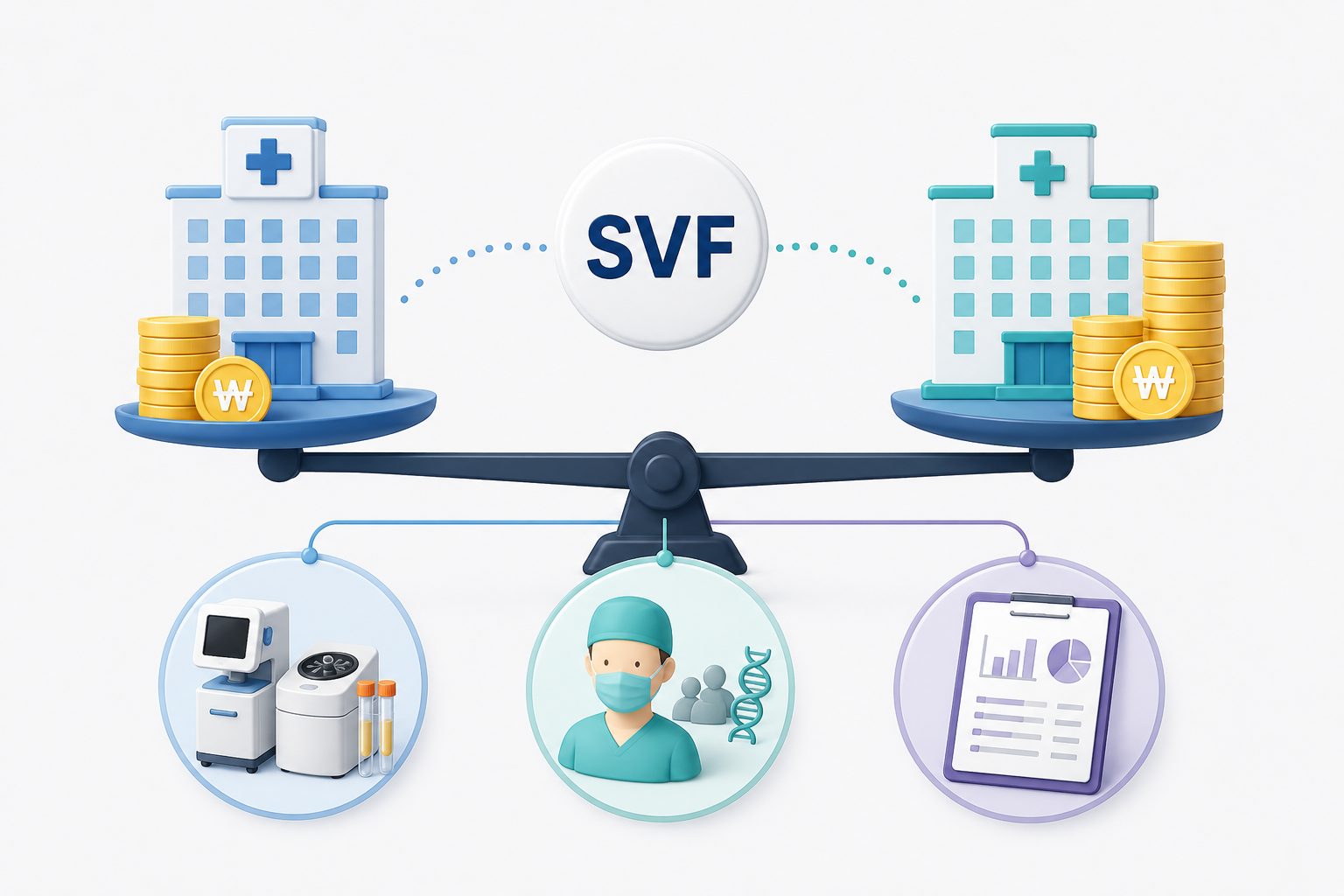
Stem cell (SVF) breast augmentationEven if the name is the same, the processes carried out within it can vary from hospital to hospital. Equipment and management environments, the proficiency of medical and research personnel, and the hospital's accumulated Quantity and quality of clinical data — These three axes combine to create an actual estimate.
In other words, having the same name does not mean the process is the same, and that difference is reflected in both the stability of the results and the cost.
Variable One — 'Safety Margin' of Materials and Management Environment

The top priority in plastic surgery is Safety.
Since implants involve inserting external material, over time... Problems like obsolete constructionThe possibility of this occurring cannot be completely ruled out. General fat grafting also If the survival rate is low There are cases where it is difficult to maintain volume or it leads to revision surgery, and in such cases, not only the physical burden additional cost burdenIt also gets bigger.
Stem cell (SVF) breast augmentation...in order to reduce these limitations SVF (Adipose-derived cell component)We focus on creating an environment where local areas can stably take root by utilizing them together. The difference in the level of equipment and hygiene systems that create this environment is soon safety marginAnd the larger this margin, the more it is reflected in the costs.
Variable Two — Hand proficiency in handling the purification process

Even with good equipment and materials, the person handling it proficiencyThe completeness of the result varies depending on this.
SVF Gangnam breast augmentation is not just simple fat grafting. Adipose-derived cell componentsof Separation, Management, and MixingIt involves a precise process. SC301's research team handling this process consists of experts with over 10 years of experience, and the patient's condition and protocolWe proceed with the work meticulously according to...
As such, who is in charge of this process and with what level of skill is an invisible factor that affects both results and costs.
Variable set — the weight of data built on evidence
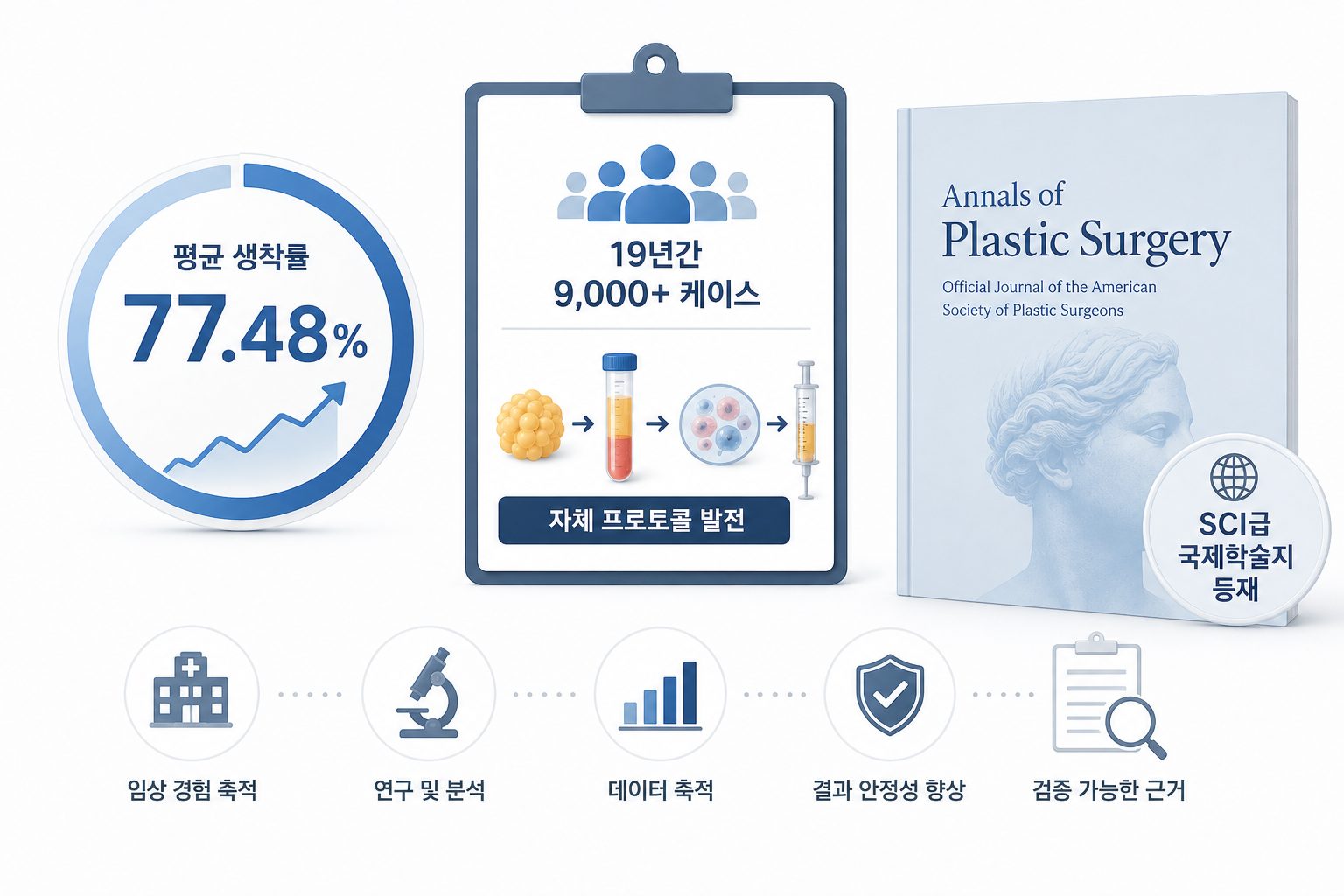
Stem cell (SVF) breast augmentationAs clinical experience and research accumulate Average survival rateThis is a procedure that improves the stability of the results.
SC301 has been for 19 years Over 9,000 casesWe have developed our own protocol based on, and the resulting Average engraftment rate 77.48%We have published and released this in the SCI-indexed international academic journal *Annals of Plastic Surgery*. (Engraftment rates may vary depending on individual constitution and lifestyle.)
This data differs from other variables in that it is not promotional material, but evidence that patients can verify.
Divide the quotation items like this.
To elaborate on the checklist provided earlier, you can divide and compare the items as follows.
Even with the same total amount, the actual cost burden can vary significantly depending on whether these items are included.
Questions to Ask When You Receive a Low Quote
If you have received a noticeably low quote, I recommend asking the following questions as well.
● SVF Extraction and PurificationDo you actually conduct this at your own facility?
● Is pre- and post-surgery care included in this quote, or is it an additional cost?
● Presenting survival rate Source (papers, etc.)Can you check?
● What are the costs if revision surgery is necessary?
If the answers to these questions are unclear, the current price difference could actually result in greater costs and burdens later on.
Frequently Asked Questions
Q. Is the result always better the higher the quote?
A. They are not necessarily proportional. However, comparing based on three axes—safety margin (equipment and management environment), proficiency, and supporting data—allows for a much more practical assessment than a simple price comparison.
Q. What happens if pre- and post-management are missing from the estimate?
A. Since there is a possibility that additional costs may be incurred or that management itself may not be sufficient, it is highly recommended that you verify whether it is included before signing the contract.
Q. Can the graft survival rate figures be trusted at every hospital?
A. It is necessary to verify the basis of the cases and the method used to calculate the figures. Checking whether the figures are cited in objective sources, such as academic papers, helps in assessing reliability.
Introduction of the surgeon
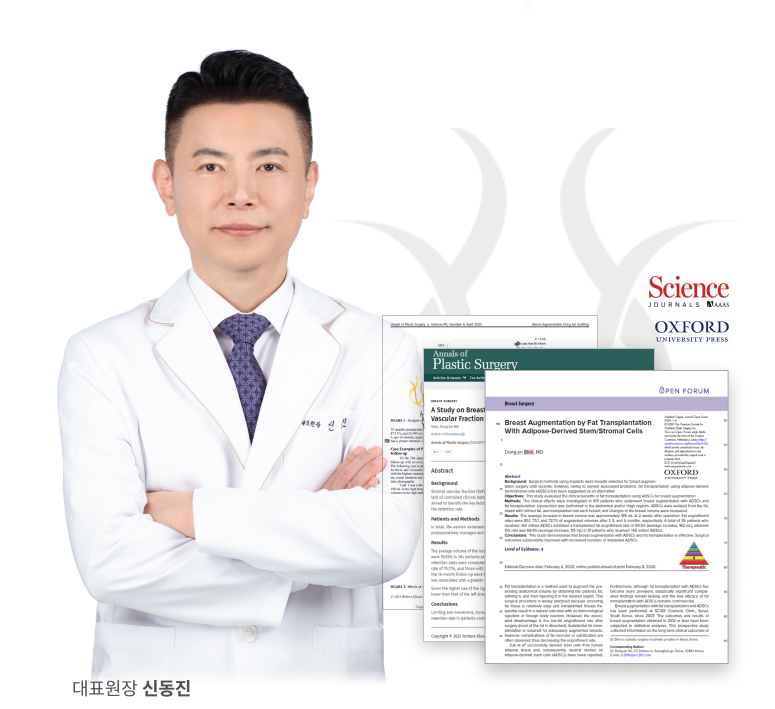
This article Stem cell (SVF) breast augmentation This document was written based on the clinical standards of Chief Director Shin Dong-jin (19th year, over 9,000 cumulative procedures performed), who has established the field. He served as the President of the Korean Society of Stem Cell Plastic Surgery for 10 years, and Up to 2–3 cases per dayWe maintain the principle of performing only surgeries.
As I organize

The numbers on the estimate are not the result Course Summary.
✔️ Whether the safety margin (equipment/management environment) has been checked
✔️ Whether you checked the proficiency of the personnel in charge
✔️ Whether supporting data is disclosed objectively
✔️ Whether you confirmed whether pre- and post-care are included
We recommend that you compare quotes after reviewing these four points together.
The most important thing in Gangnam breast augmentation is 'price'not this Safety and satisfactionPlease keep this in mind. If you are considering breast augmentation, please take your time browsing through other articles in the SC301 Seongchelin Guide.
Procedure costs and results may vary depending on hospital policies and individual constitution and fat conditions. The information above is for reference only, so please confirm accurate costs and diagnosis through an in-person consultation.
This has been the SC301 Seongchelin Guide!


Frequently Asked Questions
Why do prices vary from hospital to hospital for the same stem cell (SVF) breast augmentation?
Although the name "Stem Cell (SVF) Breast Augmentation" is the same, the actual procedures can vary from hospital to hospital. An actual cost estimate is determined by the combination of three pillars: equipment and management environment, the proficiency of medical and research staff, and the quantity and quality of clinical data accumulated by the hospital. Just because the name is the same does not mean the process is identical, and these differences are reflected in both the stability of the results and the cost.
What should I check first when I receive a quote?
Please check whether the cost of SVF extraction and purification is listed as a separate item, whether the pre-operative preparation process is included in the estimate, whether the duration and frequency of post-operative care are specifically stated, whether the source of result indicators such as engraftment rate is indicated, and whether information regarding additional costs is provided if re-surgery is required.
Does the higher the quote, the better the result?
They are not necessarily proportional. However, comparing based on three axes—safety margin (equipment and management environment), proficiency, and supporting data—allows for a much more practical assessment than a simple price comparison.
What happens if pre- and post-management are missing from the estimate?
Since there is a possibility of additional costs or insufficient management, it is highly recommended that you verify whether it is included before signing the contract.
Can the graft survival rate figures be trusted at every hospital?
It is necessary to verify the basis of the cases and the method used to calculate the figures. Checking whether the figures are cited in objective sources, such as academic papers, helps in assessing reliability.
How are equipment and management environments reflected in the costs?
Stem cell (SVF) breast augmentation focuses on creating an environment where fat can settle stably. The difference in the quality of the equipment and hygiene systems used to create this environment constitutes the safety margin, and the larger this margin, the more it is reflected in the cost. SC301 Clinic holds a cell processing facility license (No. 139) equipped with GMP-level sterile facilities and precision separation and inspection equipment.
Why is proficiency important in the SVF purification process?
Even with high-quality equipment and materials, the quality of the final result varies depending on the skill level of the operator. This is because Stem Cell (SVF) breast augmentation is not simply fat grafting, but involves a precise process of separating, managing, and mixing fat-derived cell components. At SC301 Clinic, this process is handled by a research team specializing in cell science with over 10 years of experience. The surgery is also performed personally by Chief Director Shin Dong-jin, who has 19 years of experience in Stem Cell (SVF) breast augmentation.
What should I ask if I receive a noticeably low quote?
I recommend that you also ask whether SVF extraction and purification are actually performed in-house, whether pre- and post-operative care is included in the quote or is an additional cost, whether the source of the stated engraftment rate can be verified, and what the costs would be if re-surgery becomes necessary.
Can a cheaper procedure end up being more expensive in the end?
With standard fat grafting, a low survival rate can make it difficult to maintain volume or lead to revision surgery, resulting in significant physical strain as well as substantial additional costs. If the cost breakdown is unclear, a price difference now could result in much higher costs later on.
What is the basis for the graft survival rate disclosed by SC301?
SC301 Clinic has developed its own protocol based on over 9,000 cases over the past 19 years, and has published and disclosed the average engraftment rate of 77.48% calculated through this process in the SCI-indexed international journal *Annals of Plastic Surgery*. The engraftment rate may vary depending on an individual's constitution and lifestyle.


